
The White Stripes’ 2001 song “Little Room” succinctly captures the conundrum of rising popularity alongside the creative process in 50 seconds. This may be true for most music artists, but there’s a bite that comes with recording your first album. Your dreams of stardom are so scary, but as real as ever. Pieces of paper adorned with raw, unfiltered lyrics and not-so-perfect instrumentation slowly, but surely become a realized body of work. If, by chance, it becomes popular, things will arise to pull you away from your purpose with every subsequent project. There may come a time when you have to “figure out how you got started sitting in your little room” once again.
Writer/director Scott Cooper’s “Springsteen: Deliver Me from Nowhere” picks up in 1981, where “The Boss” is looking directly at his continued ascent into superstardom as “Hungry Heart” becomes a staple on popular radio stations. The 1980 double album, “The River,” wasn’t Bruce Springsteen’s first album; rather, it was his fifth, an 18-month labor of love born out of a previous project the singer/songwriter ended up cancelling. (We will come back to an aspect of this.) Any artist would be elated to break through, but now Springsteen (played by a reflective Jeremy Allen White) is in retreat. Not only does he reject the accolade, but the song makes him wince. He becomes a recurring staple at Asbury Park’s passionate, small, and sweaty Stone Pony concert hall to ground himself with grounded hometown support.

“Deliver Me From Nowhere” / Photo Credit: 20th Century Studios
This sense of yearning to uncover what 2006’s “Rocky Balboa” would call “the stuff in the basement” would lead to Springsteen’s lo-fi, deeply personal “Nebraska.” Cooper’s film, based on Warren Zanes’s 2023 Springsteen biography of the same name, is deeply rooted in process – whether it be quick looks of the singer toiling away in his Colts Neck home, recording songs on a four-track player, and gaining inspiration from watching films like “The Night of the Hunter” and “Badlands.” The former is one of the tentpoles of a pertinent “Deliver Me From Nowhere” sub-plot, Springsteen’s fraught early relationship with his father Douglass (Stephen Graham).
It’s integral to the film, yet it highlights its shortcomings in its portrayal of certain relationships during the time period of Springsteen’s life. Regarding Douglass’s essence, Cooper chooses to split the difference between black-and-white flashbacks showing a young Bruce in a rocky, uneasy home and current-day Bruce driving up to the abandoned house, entrenched in melancholy. The surface-level depiction extends to Springsteen’s relationship with Faye (Odessa Young), a single mother with whom he has a brief romantic relationship. Her character serves as a totem of the singer’s commitment issues and the inner storm brewing within him. Even as Young gives a charming performance, you know where this union will end up, given Springsteen’s own history.
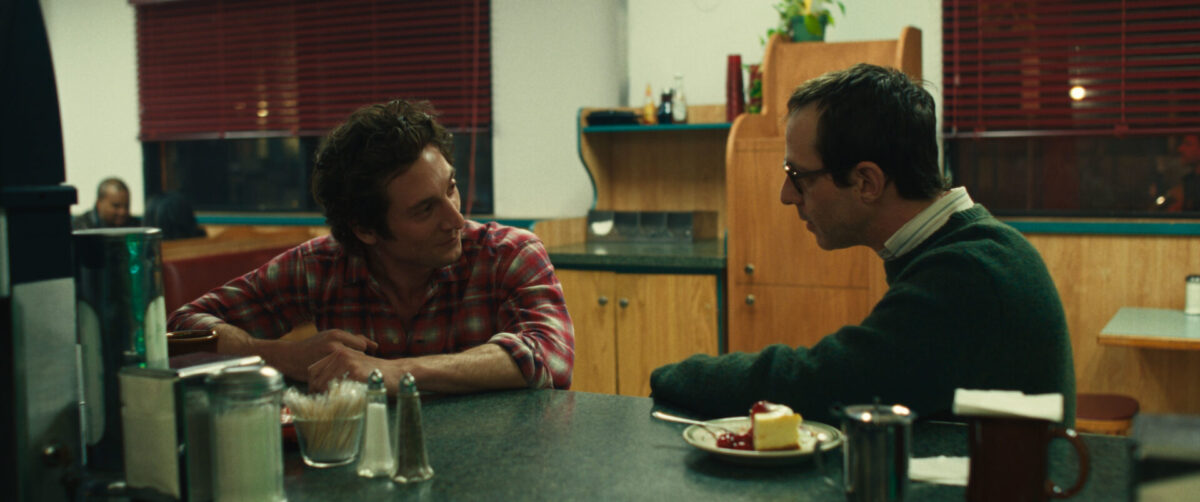
Where the film is successful is in depicting the close kinship in Springsteen’s relationship with his manager, Jon Landau (Jeremy Strong) — but only when it gets out of the way of the album. Some of their dialogue is put through the lens of conveying to the audience the importance of “Nebraska.” The album was composed right around the same time Springsteen recorded “Born In The U.S.A.” A push-pull dynamic is created: the record label wants the eventual mega-hit, while Springsteen insists on releasing recordings on their own merits—no tour and no promotion. For every interesting tidbit on pulling back the curtain of how the unfiltered sound was preserved, there’s another scene where Allen’s spirited motivation is explaining what the audience is already seeing.
“Deliver Me From Nowhere” / Photo Credit: 20th Century Studios
Much can also be said for certain scenes with Strong’s Landau. The beauty of their friendship lies in the quiet moments when Landau is aware of Springsteen’s deepening depression and speaks to it as a person of concern, not as someone merely interested in the music. A piece of “Deliver Me From Nowhere” is devoted to Landau’s discussions with his wife, Barbara (Grace Gummer), as he seeks to make sense of Springsteen’s mental journey in relation to his musical one. It feels as though Cooper uses Strong’s portrayal as an avatar not only of the fans in that time, but as a composite of those closest to Springsteen, besides his best friend Matt (Harrison Gilbertson). As it concerns performances, White fully gives himself over to the passionate, almost guttural way Springsteen sings his songs, as in “Born In The U.S.A.” at the Power Factory or “Born To Run” at the beginning of the film.
However, it feels like that attention to detail is let down by “Deliver Me From Nowhere’s” conventional routing. For an album that marks a credible shift in Springsteen’s life and career, the crescendo of pain that forged it is given a footnote near the film’s end. Rather than sit with the heaviness in the choice Springsteen ultimately makes, Cooper’s biopic looks to get to the triumphant biopic beat. In 1979, Springsteen began work on what would become “The Ties That Bind,” but scrapped it in favor of “The River.”
This biopic tells the story of the singer’s unwavering and almost magical inner compass, electing to shelve “Born In The U.S.A.” in favor of “Nebraska.” The bet proved to be successful, reaching number three in the US and being regarded as one of Springsteen’s greatest works. Despite that, a darker attachment exists to this soul, barring testament of the challenging work of healing; something the film takes an interest in stating. But “Deliver Me From Nowhere” is a plane that thrives because of the turbulent, dark skies it finds its way back home within. Yet, the film feels like it would rather be sitting in the safety of the tarmac.