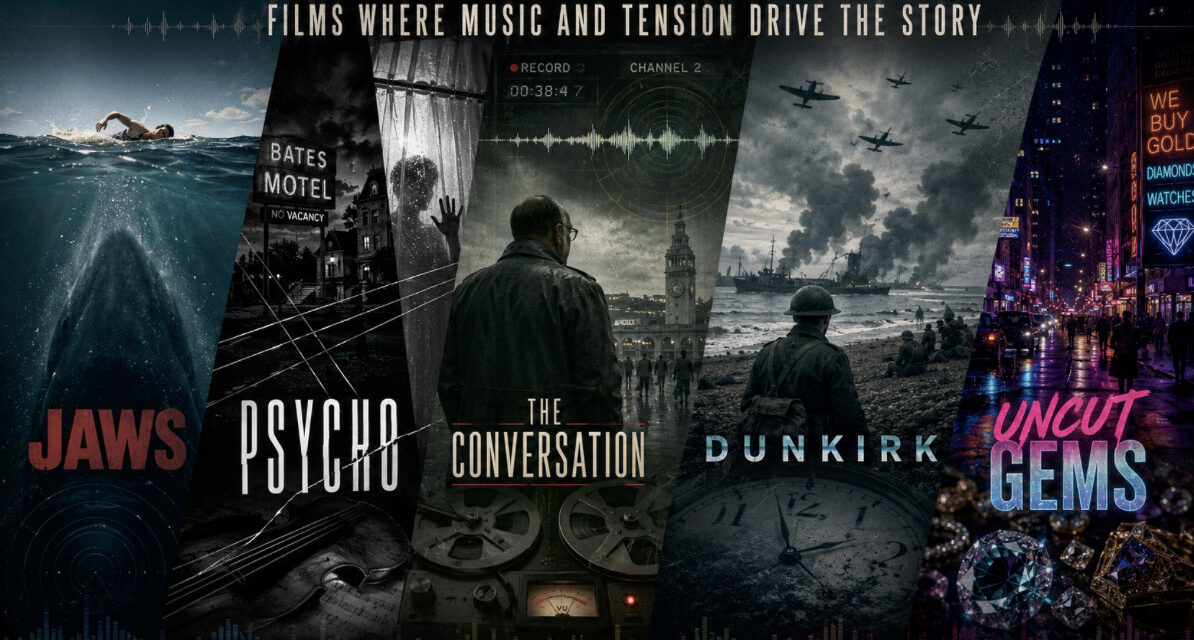
The first 10 minutes of a tense film often do more work than the next hour. The plot may still be quiet, but the score has already told the body to worry. Harmony shifts. Tempo drifts. A motif appears before the viewer knows its meaning.
That is how Jaws, Psycho, The Conversation, Dunkirk, and Uncut Gems pull the audience forward. They do not wait for explanation. They plant discomfort early and let the story catch up.
Jaws: Two Notes Become a Threat
John Williams made Jaws terrifying with one of cinema’s simplest musical ideas. The opening attack begins with water, darkness, and an almost animal pulse. The famous low motif works because it narrows the emotional field. Viewers do not need to see the shark. The music has already made it present.
The technique is brutally economical: repetition, rising tempo, low register, and unresolved pressure.
Psycho: Strings Cut Before the Knife
Bernard Herrmann’s Psycho score uses an all-string sound that feels cold, tight, and monochrome. In the opening stretch, the music does not merely support noir tension; it traps the film inside nervous motion. The harmonies feel cramped. The phrasing refuses comfort.
By the time the shower scene arrives, the score has already trained the viewer to hear danger in sharp string attacks.
Screen Tension and Digital Attention
Tense cinema works because the viewer starts reading signals before the plot explains them. Betting audiences do the same thing with odds movement, team news, injury reports, and live-market pauses. A mobile user checking online betting Philippines during a match is also reading the rhythm: price changes, timing, probability, and pressure. That habit is closer to film scoring than it first appears. Both experiences depend on anticipation before resolution.
Live formats use a different kind of tension because the event unfolds in real time. A roulette wheel, blackjack table, or baccarat shoe creates suspense through pace, dealer movement, and visible sequence. A strong live casino section works when it maintains a clear rhythm, with readable tables, stable streaming, and fast navigation between games. The tension is not cinematic in the scripted sense. It comes from waiting for an outcome that has not been edited for comfort.
Slot design borrows more from film atmosphere than many players notice. Sound cues, expanding reels, bonus-trigger music, scatter animation, and near-miss pacing all shape how a session feels. Well-built online casino games use those cues to separate a routine spin from a feature moment. The math still sits in RTP, RNG, and volatility. The emotion sits in timing, sound design, and visual escalation.
The Conversation: Paranoia in a Piano Line
David Shire’s score for The Conversation sounds lonely before the surveillance plot tightens. The piano theme feels exposed, almost unfinished. Small harmonic shifts make Harry Caul’s world feel unstable without turning the film into melodrama.
The first 10 minutes are full of distance: public space, recorded voices, fragments, and professional control. The music quietly breaks that control. It suggests that the man doing the listening may be more fragile than the target.
Dunkirk: The Tempo That Never Lets Go
Hans Zimmer’s Dunkirk score uses the Shepard tone idea to create the sensation of endless rising pressure. The film’s opening does not rely on a traditional heroic theme. It uses pulse, ticking, breath, and sound mass.
The first 10 minutes feel as if time has started leaking. The viewer hears danger before understanding the full geography of land, sea, and air. That is the trick: the score turns structure into stress.
Uncut Gems: Anxiety as Musical Weather
Daniel Lopatin’s Uncut Gems score does something stranger. It does not simply make the film tense. It makes Howard Ratner’s world feel too bright, too loud, too cosmic for the grubby rooms he occupies.
The opening shifts from a gemstone interior to human obsession, and the music lends that transition a surreal charge. Synths swell where a crime thriller might usually tighten. The result is anxiety with glitter on it.
What These Films Do in the First 10 Minutes
| Film | Composer | Early tension device |
| Jaws | John Williams | Minimal motif, tempo escalation |
| Psycho | Bernard Herrmann | Dissonant strings, tight harmonic pressure |
| The Conversation | David Shire | Lonely piano, subtle distortion |
| Dunkirk | Hans Zimmer | Shepard tone, ticking pulse |
| Uncut Gems | Daniel Lopatin | Dense synth texture, emotional overload |
The plot may open the door. In these films, the music is already inside the room.