
When Lily Allen dropped West End Girl in October 2025, she did something very few pop stars have the nerve to do: she named her interior designer in the lyrics. “Billy Cotton got sorted, all the furniture ordered,” she sings on the title track, recounting the purchase of a Carroll Gardens brownstone that would become, in hindsight, both the backdrop and a character of her marriage to David Harbour. The album (her first in seven years, now sitting at number 33 on Rolling Stone’s 100 Best Albums of 2025) is a forensic account of a relationship falling apart. The house, inevitably, was part of the story.
The brownstone at 381 Union Street hit the market last October at just under $8 million, days after the album’s release. It has since sold. Allen’s taste is the kind that confounds anyone who assumes musicians default to either minimal or maximalist clichés: her home swung wildly between the two, from rooms that would sit comfortably alongside Poliform modern luxury pieces to corners that looked like a Victorian cabinet of curiosities. Designer Billy Cotton and architect Ben Bischoff of MADE had full creative latitude, and they used it.
If David Harbour Found the Brownstone, Lily Allen Made It Famous
There is a line on the album that lands differently once you’ve seen the house. “I could never afford this,” Allen sings, right after the Billy Cotton shoutout. She said the same thing to journalists, more than once. On the Miss Me? podcast, she talked about being a stay-at-home mum for five years and now facing life as a single mother who has to work. The brownstone (bought for $3.35 million in 2021, renovated extensively, listed at nearly $8 million) was always David Harbour’s financial leverage as much as it was their shared home. Selling it for $7 million, a year after the split went public, was the last transaction in a very expensive marriage.
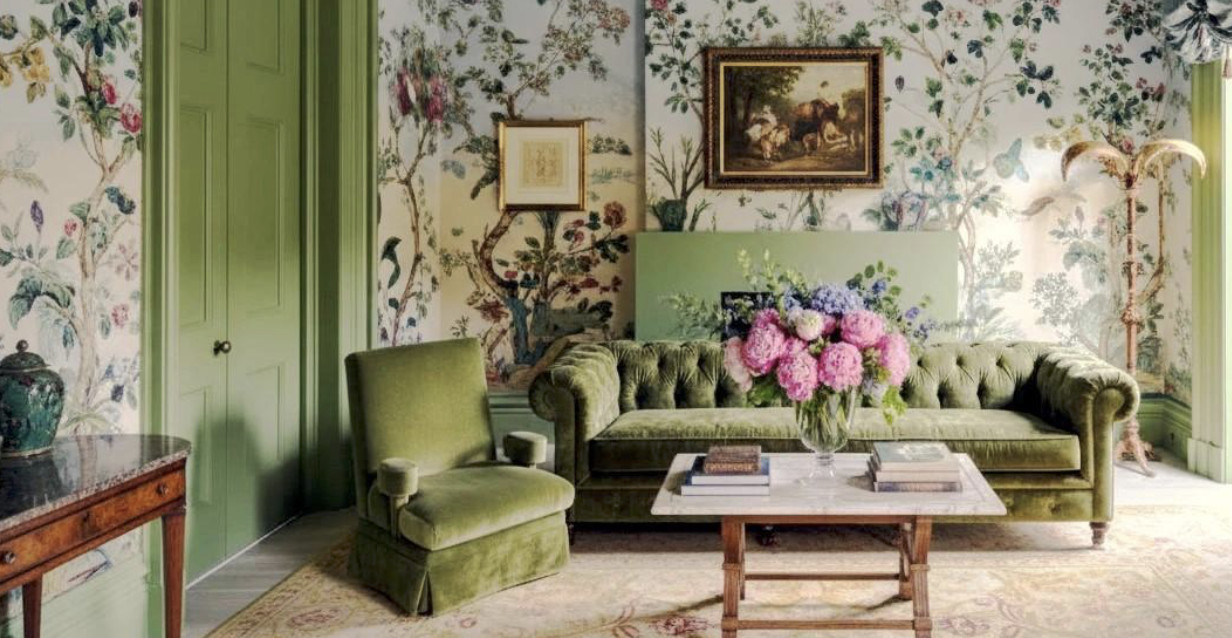
Billy Cotton, for his part, built something that had Allen’s personality written into every surface. Each room ran on its own internal logic. The living area (she called it the “garden room”) had Zuber wallpaper, a ceiling painted apple green, a custom double-sided sofa in Pierre Frey velvet with Houlès fringe, and a 19th-century English chandelier with black lampshades that reportedly cost $9,000. A Pier Luigi Colli cocktail table. A Venetian chair pulled up to a Louis XV bureau plat below a Shara Hughes painting. It was not a room designed to be calming. It was designed to be inhabited noisy.
No Song About the Kitchen, Just a Really Good One
The kitchen was the one room where Cotton pulled back. Plain English cabinetry in cream, an Ann Sacks backsplash, an Officine Gullo range. A custom banquette in plum-colored Claremont check fabric along the windows. No Zuber, no velvet fringe, no tiger stripe.
Carroll Gardens has been an Italian-American neighborhood for over a century, and the kitchen leaned into that. cream tones, honest materials, something that felt inherited rather than purchased. Plain English is a British brand, handmade, the kind of cabinetry that takes months to arrive. Here it reads like a Brooklyn nonna’s kitchen. Cotton made expensive feel local, which is harder than it sounds.
By his own admission on Late Night with Seth Meyers, Harbour made “very few decisions” about the house. The kitchen, at least, didn’t require defending.
A Maradona Poster, a Tiger Sofa, and a Loro Piana Staircase: The House That Explains West End Girl
Downstairs was where things got genuinely strange. The den had the sofa and carpet covered in the same Le Manach Tigre Cambridge print, sourced through Pierre Frey; the same tiger stripe, floor to wall, no apologies. Violet velvet cushions. A framed Diego Maradona poster. Sconces by Liedekerke, a side table by Banci Firenze for Gucci. Paintings by Tabboo! and Richard Tinkler. It is possibly the most committed room featured in Architectural Digest in recent memory: a room that made a decision and never second-guessed it.
That quality (full commitment to a vision, no hedging) runs through the whole house. The primary bathroom was designed as a sitting room that happened to contain a bath. Wall-to-wall Pierre Frey floral carpet, Zuber wallpaper, a pale pink tub, Henri Caillon armchairs, an original marble fireplace, and a small round marble-top table with slender black legs. Louis XVI-style commodes converted to washstands. An Irish rock-crystal mirror. Ralph Lauren Home sconces. The toilet was in a separate room. Apparently the bath was for thinking.
The staircase was lined in Loro Piana striped cotton velvet. The dressing room had custom Florense closets. The children’s bathroom was wrapped in China Seas Mylar wallpaper through Quadrille: powder blue, its own parallel universe.
Sold the House. Sold Out the Tour.
Allen is now on the road performing all of this out loud.
The West End Girl tour launched in Glasgow in March 2026 and runs through November: sixty shows across the UK, North America, Australia, and New Zealand. She performs the album in its entirety, in track order, every night. The theatre dates sold out immediately; she added arenas. Rolling Stone called the record “the most brutal album of the year.”
She told Vogue she couldn’t move on until she’d said everything it says.
The brownstone is someone else’s now.
Whatever they make of the tiger room is their business.