
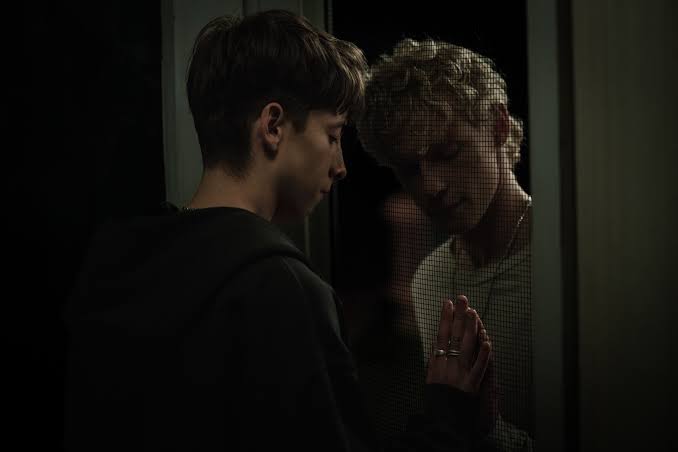
We gravitate to the “star-crossed lovers” trope because love seems to be one of the only things that can get through the muck of conventional life. It often transcends death itself. The stories of people who fully embrace it often etch their names into time. But not everybody gets to experience those moments equally. For marginalized groups, it’s not as simple as overcoming two warring families and professions from a balcony. What Adrian Chiarella’s first feature, “Leviticus,” shows is that some people have to fight two different battles to love — whether it be battling the views and systems people abide by (and thus, expect everyone to follow) — and the battle of self.
Naim (Joe Bird) and Ryan (Stacy Clausen) are first seen joking around with one another and breaking into an abandoned warehouse. Their play-fighting soon turns into a romantic embrace, and as quickly as it happens, the audience realizes that their small, Australian town would not be accepting of this same-sex union. They both give each other a sorrowful acknowledgment that their affection must remain a secret. Chiarella’s depiction of Victoria, Australia, shows that the spirit and the people within it are stuck in a continuum of once was. Steel mills and industrial buildings are encased in a shade of brown and hollowed out. All that’s left to cling to is the local church, where the townspeople try to make sense of things.
It’s a major reason Naim’s single mother (Mia Wasikowska) decided to move them there. But Naim knows he doesn’t specifically belong there – his tryst with Ryan is the only saving emotional grace. However, that all starts to unwind when Naim unexpectedly catches Ryan kissing the preacher’s son Hunter (Jeremy Blewitt). His anger and feelings of betrayal led him to tell Hunter’s father what happened, and the insidious undercurrent of the town began to show itself. A traveling preacher (Nicholas Hope) does a religious ritual on the boys (which is more of a metaphor for conversion therapy), and a violent, physical reaction occurs as a result.
What happens after is far more dire and disturbing. Drawing inspiration from “It Follows,” each person who undergoes this “religious exorcism” is stalked by a demon that takes on the physical form of the person they desire most. Each encounter becomes more concussive and ferocious than the next — an effective device Chiarella uses to both depict the repression of desire and the shame outside forces place upon the queer community — who want to exist in happiness without judgmental eyes and voices. The word “Leviticus” refers to the third book of the Bible, and it outlines how to worship and the laws people had to follow. Religious detractors of queer relationships often point to the verse of Leviticus 18:22 as a method of condemnation. How is the act of love unclean and unholy for some, but something to be celebrated for others? This is the question Chiarella asks, in a confrontational manner — needed in a world that disregards the seriousness of such provocation.
Chiarella allows the believability of his actors and the visceral nature of his allegorical device to take the lead with gusto. Bird and Clausen exhibit genuine sentimentality toward Naim and Ryan, making you want them to experience some reprieve. As the film goes on, both lead actors become the embodiment of anxiety. Wasikowska exudes a growing coldness in her role, becoming a metaphorical foil to her son in this story. It’s as if the devotional religious tie to being in Victoria also acts as an entity, formulating viewpoints in different ways. Aside from conventional horror jump-scare set pieces, there’s a relentlessness to how this demonic force manifests itself, underpinning its seepage into every instance of vulnerability. “Leviticus” uses gore and vehemence in a manner that doesn’t distill the real terror of being in a place where being who you truly are can kill you.
The scariest part of “Leviticus” is on the outside, the fictionalized town of Victoria seems glossy and accepting. It’s when you peel the layers back that you see not only that’s not the case, but realize there are small towns across the world in which LGBTQ+ identifying people are experiencing their own manifestations of daily anguish. Media like “Heated Rivarly” have inspired their own devoted fandoms for queer romance stories, but the sad reality is that parts of the world are refusing to catch up. Chiarella’s film depicts the same fits of passion, but with a supernatural twinge to show the hair-on-fire realism to where our tried-and-true tropes lose their muster when everyone does not experience them.
“Leviticus” was reviewed at the 2026 Sundance Film Festival.