
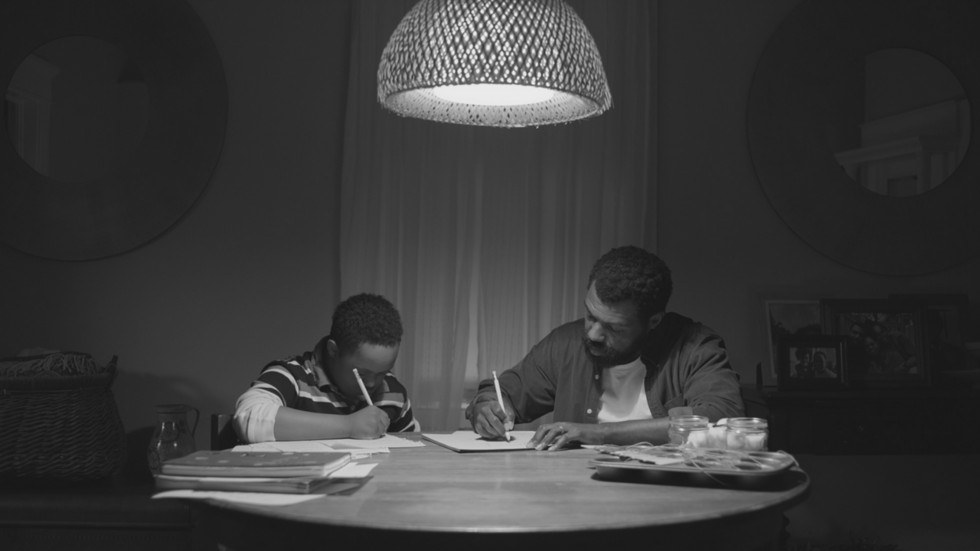
Towards the beginning of director David Fortune’s beautifully constructed black-and-white drama, “Color Book,” Lucky (William Catlett) puts his 11-year-old son Mason (Jeremiah Alexander Daniels) to bed. There’s a space where Lucky says to Mason, “It’s just going to be me and you. You good with that?” to which Mason nods – with both uncertainty and understanding in his eyes. Not to leave the moment hanging, Lucky immediately goes into a pose down, gritting his teeth and showing his muscles, with his son emulating the moves. It’s a simple ritual, but an ingenious marker that speaks to the unintended tragedy they both have to face together.
Death is a certain part of life, but there’s something to be said when it sneaks up on you and snatches someone you love without an inkling of warning. It’s a thief that keeps on stealing things: joy, time, and the carefree nature of living in the moment without pause. Fortune’s story mostly centers around a singular day in Lucky and Mason’s lives when they try to go to a baseball game. This step is where they are trusting each other to move in a future without Mason’s mother, Tammy (Brandee Evans), who died in a tragic car accident.
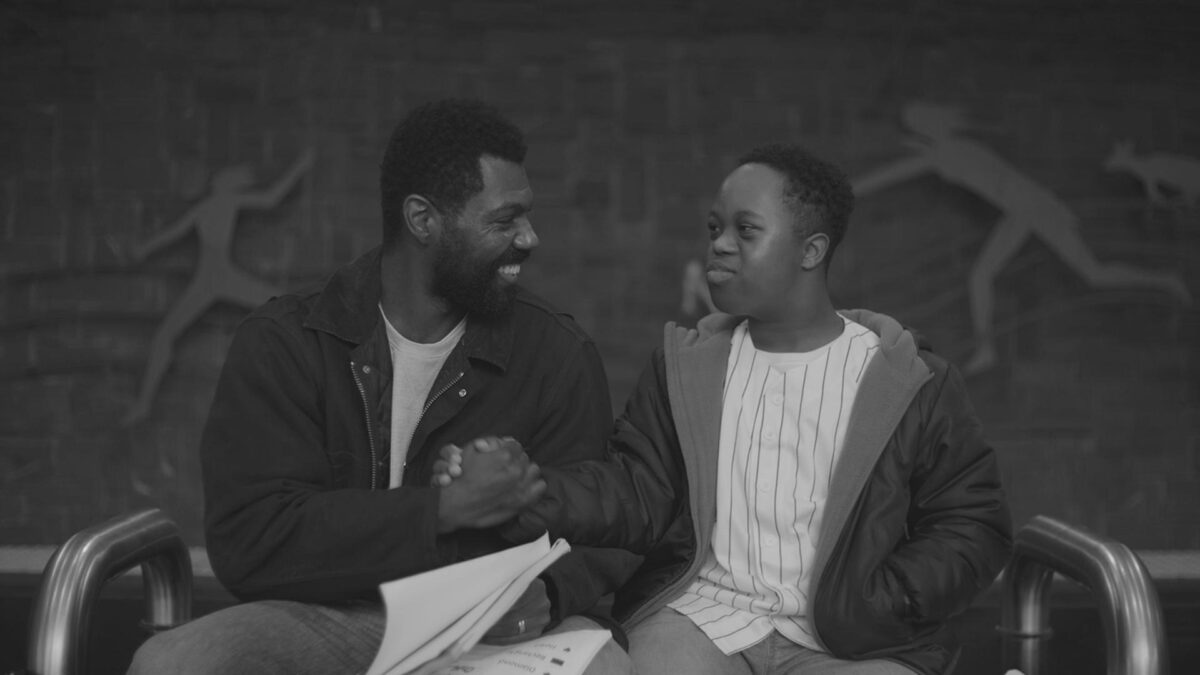
“Color Book: | Credit: Netflix
It’s not only a story of bonding between father and son and the difficulties that entails within one day, but it’s also a moving monument. During a memorial service, people from the neighborhood speak about how warm and amazing Tammy was. Lucky tries his best to keep his son’s life, who has Down syndrome, as normal as can be. They make beaded necklaces together as he did with Tammy and work on spelling exercises. But slowly, within his own internal struggle, Lucky is quick to anger. It’s more in the vein of frustration with the circumstances his small family has been dealt and the scariness of being half of a parenting whole.
A duality exists concerning Fortune’s title of the film and its colorless palette. The landscapes may not be bursting with blues, greys, or yellows from the sunshine, but we can feel them. A single white balloon Mason carries in honor of his late mother stands out and pops. The deliberate song choice of using Roy Ayers’s “Everybody Loves the Sunshine” gives Lucky and Mason a brief happy reprieve, lightens the mood, and the film follows. Fortune proves that the lo-fi quality can act as its own palette. The road to America’s pastime is not exactly easy. On the way to the ballpark, they have to make a stop at the junkyard to get Tammy’s belongings out of her totaled car. There are quiet moments of tears Lucky can shed, gripping her arts-and-crafts bracelet bearing her name. The quick moment of acknowledging his pain is hidden in an instant when he hears Mason.
“Color Book” is an exquisitely orchestrated testament to Black fathers and the many hats they have to wear in helping their children move through the world. For every moment of exhaustion and agitation, Lucky is quick to find happiness in a day not exactly going to plan. On a train ride, they play thumb wars, and they sing and jump when they initially decide to go to the baseball game. Through a sad situation, the normal moments give the viewer a sense of “everything will eventually be okay.” But Caletti and Daniels show that, in different ways, both Lucky and Mason experience grief.
There’s a pivotal sequence where a man selling balloons comes on the train, and Mason asks his dad for one. Mason tells him no, and in the tiredness of the day, he falls asleep. When he wakes up, he realizes his son had gotten off the train to follow the man. In that moment, you become both angry and sympathetic towards him. On one hand, how could you let that happen?
On the other hand, one could recognize why Lucky had an accidental lapse in judgment. In the middle is recognizing his son’s nonverbal language as he misses his mother. It makes Fortune’s choice of Mason saying it plain at the end of the film that much more heartbreaking. “Color Book” also highlights a communal experience of Black women who fill a certain void from a variety of angles. The MTA worker who finds Mason grills Lucky for losing him from a place of protection. A waitress named Robyn (Terri J. Vaughn at a local diner exhibits motherly warmth and interest. You will never get the person you lost back, but Fortune weaves the different ways Black women show up in Lucky and Mason’s lives to show that Tammy’s spirit will still be present.
The prayers said by a father and son for protection, the projection of fireworks from a television screen, a joining of hands between Lucky and Mason with a promise to keep running to not look back – Fortune gives all of these rituals equal weight to mean so much. In reality, when we lose someone, they anchor ourselves and those who remain. Mason illustrates many of the critical scenes in his notebook because sometimes the journey is more powerful than the destination. I can’t help but reflect on the brilliant simplicity of the title of this film and all the ways Fortune expresses it without needing it to be pronounced the way we are used to.