
This review is a part of Substream Magazine’s 2025 TIFF Coverage
The party depicted in Nia DaCosta’s adaptation of “Hedda” is as much a metaphysical metaphor for our main character’s emotional state as well as a rip-roaring tentpole of upper-class wealth and excess. Hedda (Tessa Thompson) is the conductor, the destroyer, and the ultimate charismatic conductor of a 1950s England celebration. “The party, the house, it was all for you,” George Tesman (Tom Bateman) proclaims as they get ready for the upcoming evening. While the expansive estate may be too big for a newly married couple, Hedda has enough fire inside of her to heat every room. As the band breaks into Betty Hutton’s “It’s Oh So Quiet,” she’s the catalyst behind wallflowers suddenly making their way to the dancefloor.
Inside what she names whimsicality is a deep-rooted melancholy. After briefly viewing her as a subject of interrogation, DaCosta shows Hedda in her weakest moment—standing shoulder-deep in a lake with rocks in her pockets. Hedda’s contempt for her situation burns so brightly that the embers singe those around her. She’s fighting through a cavalcade of obstacles like sexism, racism, autonomy, and just pure boredom. Hedda walks on a tightrope with a sly smile to the ground below and a balled-up fist to the sky. Our antihero would love nothing more than to be her true self, but societal constraints serve as a never-ending nesting doll. So, if Hedda isn’t going to break the shape, she will surely mold it to her will.

Tom Bateman (George Tessman) and Tessa Thompson (Hedda Gabler) in HEDDA.
The writer/director’s adaptation of Henrik Ibsen’s 1891 play “Hedda Gabler” sticks to some parameters of the original story, but smart changes are made to add some additional layers. While Hedda goes around the compound throwing out certain flowers and making abrupt alterations to the party decor, she’s nervous. That’s because former lover Eileen (Nina Hoss) is planning to make an appearance. While they were together, they were mutually assured destruction and affection. Their breakup was just as raucous, supposedly with Hedda pulling a gun on Eileen. However, Eileen has changed her ways, becoming newly sober and using her esteemed intellect to be the frontrunner for the same job George is up for. She also has a best-selling book to boast about, and the conduit for this change is a new lover named Thea (Imogen Poots).
As you can imagine, Hedda does not take this news well for many reasons. Eileen is not only “the one that got away,” so to speak, but she’s unquestionably able to be herself in a repressive ecosystem. It’s a liberty Hedda herself feels she cannot do and knows that cannot be true, especially being a Black woman (another smart change by Decosta). It’s a different type of repression Eileen cannot understand, even as a queer woman fighting through the ignorant boys’ club of academia. Decosta does a great service by balancing the screenplay, showing how these two factors not only collide but also influence each character separately. Eileen’s ascent threatens Hedda’s own livelihood because she and George are in a substantial amount of debt from acquiring the mansion.
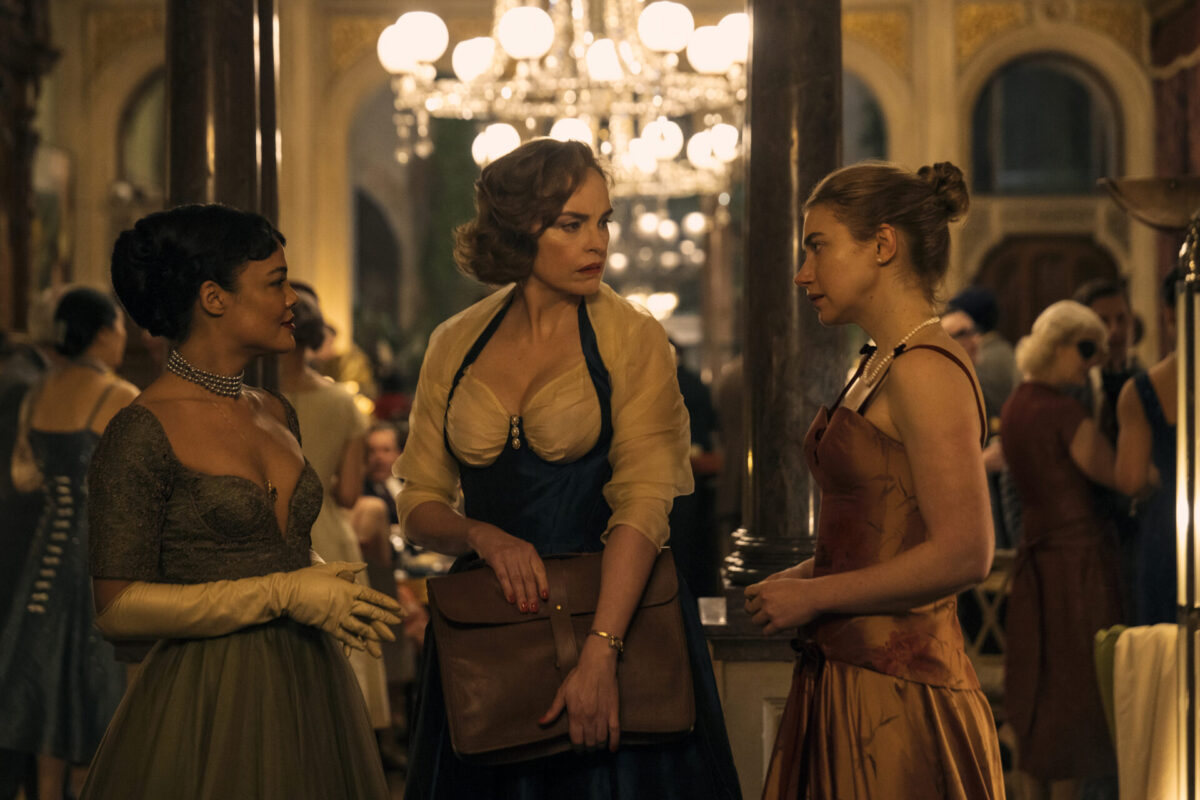
(L-R): Hedda Gabler (Tessa Thompson), Eileen Lovborg (Nina Hoss), Thea Clifton (Imogen Poots) in HEDDA.
There’s also an added layer of Judge Roland Brack (Nicholas Pinnock), who was instrumental in providing the newlyweds their new, expansive digs. To that effect, he feels Hedda should deliver herself to his unsavory desires on call. But at least at that juncture, Hedda exhibits her quick wit to get her out of a jam. The men in the film are wondering how to tame Hedda; Eileen (and, quickly, Thea) know she’s a hurricane. Within the middle, it’s delightful to see how Thompson’s character exerts her will both directly and indirectly to get a desired outcome.
Thompson’s portrayal of Hedda is captivating, as she conveys so many emotions through subtle changes in her dialogue and what she leaves unsaid as she overlooks the scenery. Hedda’s anger is unruly and unforgiving, but there’s a softness that needs connection to something. Hoss is equally great as the gender-flipped Eileen —confident in spaces where women aren’t expected to be and a little bit broken. The world demands they be hard and bold, but in their interactions with each other, they wear each other down. Hedda sees the finished product of the transformation of a woman she loves, a transformation she was not part of. Eileen is also the personification of the freedom she can’t experience. With Eileen, even as she’s moved on, love for Hedda is still present. She beckons her to be brave and even mocks Hedda’s married name by calling her by her maiden name. Despite this, Eileen still feels the pressure of a matriarchal world, constantly being told to dial things down.
Hildur Guðnadóttir’s percussion-based, jazz-like score keeps things moving along, along with Sean Bobbitt’s camera work. You feel as if you’re in front of every aspect of the party, right down to hearing the bubbles of champagne hit the glass. It’s as if we’re in a throwback “Sleep No More” experience, but placed in the hands of a captivating narrator.
Somehow, DaCosta lays out a mostly multilayered, fluid construction of Ibsen’s original story that resonates throughout the generations. At points, you’ll want to tear down the world Hedda lives in, and at other times, you’ll wince as she does that to others. Mostly, it’s a thrilling take on the extent of living freely and the methods some have to resort to out of necessity.