Once upon a time in a small town, there lived a group of kids who were afraid to go to sleep. An undead child murderer would appear in their dreams to enact revenge for his death years prior. If you happen to die while counting sheep, you’re also dead in the real world. You’re probably thinking I’m talking about a disfigured man donning a fedora, red and green sweater, with a brown glove with knives. Oh no. I’m talking about The Grabber (Ethan Hawke).
Many people were probably puzzled at the announcement that Scott Derrickson’s 2021 “The Black Phone” would be getting a sequel. The main antagonist doesn’t make it out alive, and while the film has supernatural elements, the ending seemed pretty definitive. But as a quote from “Black Phone 2” says, sometimes death is just a word. Thus, Derrickson and longtime writing partner C. Robert Cargill got to work and crafted a new nightmare. There hasn’t been a Nightmare on Elm Street film in 15 years (since the ill-fated reboot attempt), and it doesn’t look like the quagmire is ending anytime soon.

Madeleine McGraw as Gwen in Black Phone 2, directed by Scott Derrickson.
Derrickson’s sequel draws on some of the classic horror icon’s own lore while looking to build upon his own creation. While some of the aesthetic choices that drew people to the first film are still present, the film almost falls under the weight of taking on a larger-than-life property in its own playground. Instead of following a group of teenagers trying to figure out ways to thwart off never waking up again, “Black Phone 2”’s story picks up four years after the original. Finney (Mason Thames) struggles to compartmentalize his experience of being abducted by The Grabber and having to kill him, as a victim would. He’s unable to put his feelings into words, is a little bit reclusive, and prefers a joint to ease the mental pain.
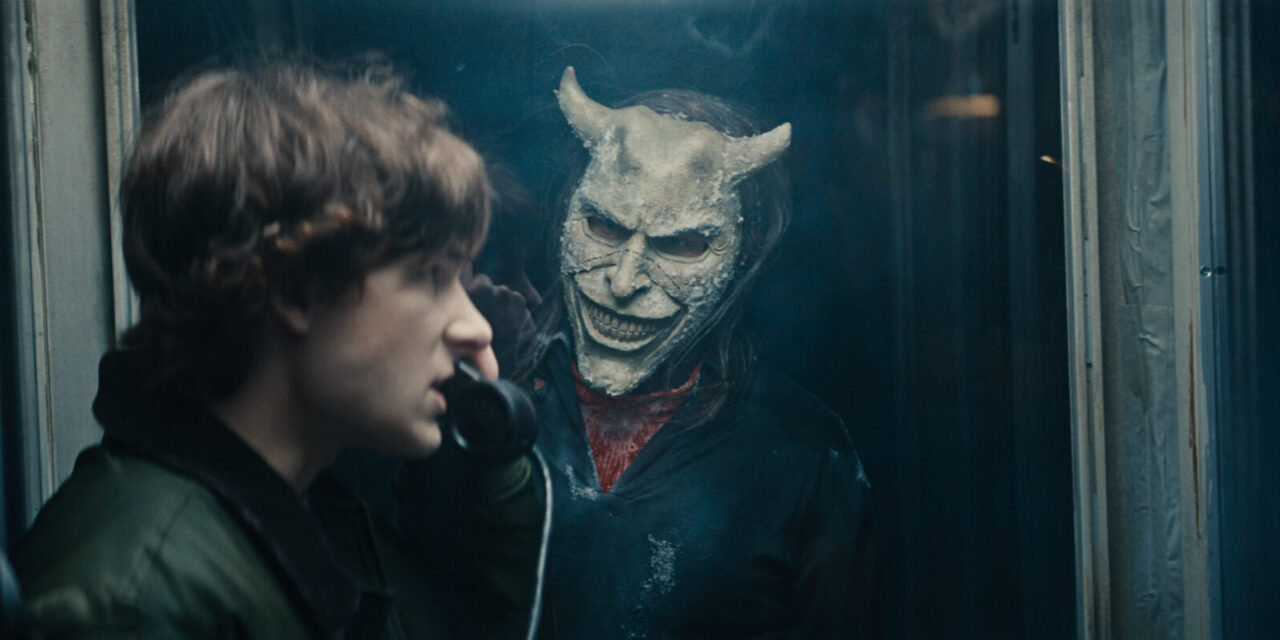
While the physical and mental wounds are still trying to heal, Finney’s sister, Gwen (Madeleine McGraw), has her own battles to fight – particularly mired in her clairvoyance. Out of nowhere, she starts to have dreams of three murdered kids with ties to a Christian youth camp named Alpine Lake. The victims try to warn Gwen of something with scrambled messages. Not to mention, she seems to be channeling a memory in 1957 of her mother, Hope (Anna Lore), making a call at a phone booth. What does this all mean? Somehow, The Grabber has returned, and the “nightmare” has just begun.

Ethan Hawke as The Grabber in Black Phone 2, directed by Scott Derrickson.
How is that even possible? Well, Derrickson and Cargill’s logic works a lot like “Nightmare On Elm Street’s” with a couple of tweaks. Since Gwen has this gift, she’s the only one who can be physically affected by him. Instead of feeding off the fear of the vast majority of teenagers, The Grabber feeds on the essence of his first victims. Of course, you have the trademark pay phone, which is a little bit of a plot convenience considering there’s a non-working one at the camp.
With these constraints, Derrickson seeks to infuse a sense of urgency into the sequel. Finney, Gwen, and Ernesto (Miguel Mora), brother of one of The Grabber’s previous victims, head to Alpine Lake to work as counselors-in-training to solve the mystery. They meet the supervisor of the camp, Armando (Demián Bichir), who is devoted to his faith and took a vow to find the missing kids. “Black Phone 2” walks the line between two worlds. When Gwen dreams, the aspect ratios change to the Super 8 style synonymous with Derrickson’s previous “Sinister” films. It’s a cool gimmick that lends itself to some horrifying imagery, serving as a window for The Grabber to impact the actual realm. As the film progresses, its reliance on this tool disrupts the story’s momentum. Chalk it up to one character having to be an all-seeing eye concerning everyone else’s blind spot.
As far as character development goes, Gwen takes the reins as a focal point. McGraw does a pretty good job with it, invoking emotion when it’s needed. “Black Phone 2” explicitly states she’s the one who will confront what happened to her and her brother throughout this time. With that, Finney’s character finds himself on the outside looking in. That’s not to say Gwen doesn’t have trauma to explore, but Finney’s character was directly impacted. There’s an emotional crescendo that reaches a fever pitch in the third act, which could have been more impactful if we had spent more time exploring Finney’s mental state. When characters like Ernesto or Armando try to dig into aspects of it, “Black Phone 2” feels a need to move in service of Gwen’s story.
Ethan Hawke’s portrayal of this incarnation of The Grabber matches the sadistic intensity of the first film. What is surprising is that, aside from a few bits of dialogue and scenes, the film doesn’t take advantage of the supernatural nature within which his character exists. For everything Derrickson and Cargill draw from considering Freddy Krueger’s character, they left a lot on the table for making The Grabber’s undead version a little more formidable and sinister as his backstory begets. At one point, The Grabber refers to himself as “a bottomless pit of sin.” Yet, his abilities feel tethered to the world where he drove a shady van around. The Grabber wants a bounty for his brother’s death, but the bark doesn’t match the bite at times.
It could be because Derrickson’s sequel is not as straightforward in its message as the original film. On the surface, it’s The Grabber vs. the survivors, but the story is speaking to metaphors of faith versus evil. Gwen has been struggling with her abilities, likening them to a curse passed down by her mother. The film serves as a vehicle for her character’s personal journey of self-acceptance, which is, in itself, a beautiful thing. That could apply to anybody, no matter what background you come from. “Black Phone 2” attempts to confine that message to the framework of a specific religion, but it’s too big to be contained in that specification.
The forces of good and the depraved will do their discordant dance forever, traversing to places we find refuge in – even in our dreams, where we can craft images of our desires and recreate vivid memories. “Black Phone 2” gives us more fuel to let us know we aren’t safe when our heads hit the pillow. But only if the film is as self-assured in its interpretation of a main character’s gifts and the uneasy way it feels about them, where it could have been bigger than an homage.