
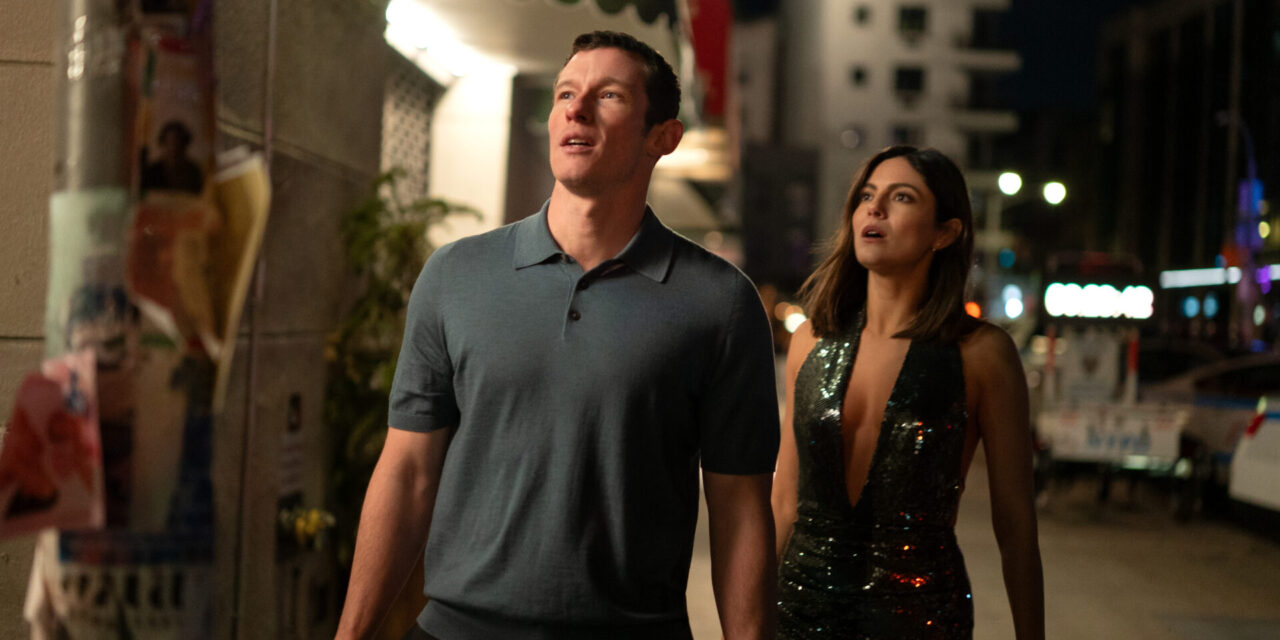
Throughout Will Glock’s romantic comedy “One Night Only,” flags and posters bearing the word “repeal” appear. It’s a hint that there may be some resistance to the “chastity mandate” implemented in this world three years prior. The “Purge but for sex” premise goes a little something like this. Premarital sex has been outlawed for 364 and a half days out of the year. Singles get 12 hours to get down to their hedonistic desires. If you have any trouble figuring out who is DTF, don’t worry — everyone has a color-changing tattoo that doubles as an “I’m here and I’m available” marker.
That’s a lot to take in and, frankly, a lot to overlook as the film tries to paint two lovers potentially finding each other in a sea of one-night stands sheen. With “The Purge” franchise, it’s simple: survive the night before some insane person takes you out. But as the films went on, they dove deeper to chronicle how the rich exploited this law to root out the poor and disenfranchised. It’s not as though the horror franchise forgot its roots, but rather it recognized the economic and societal implications that could be exploited by people who want to uphold that absurdity.
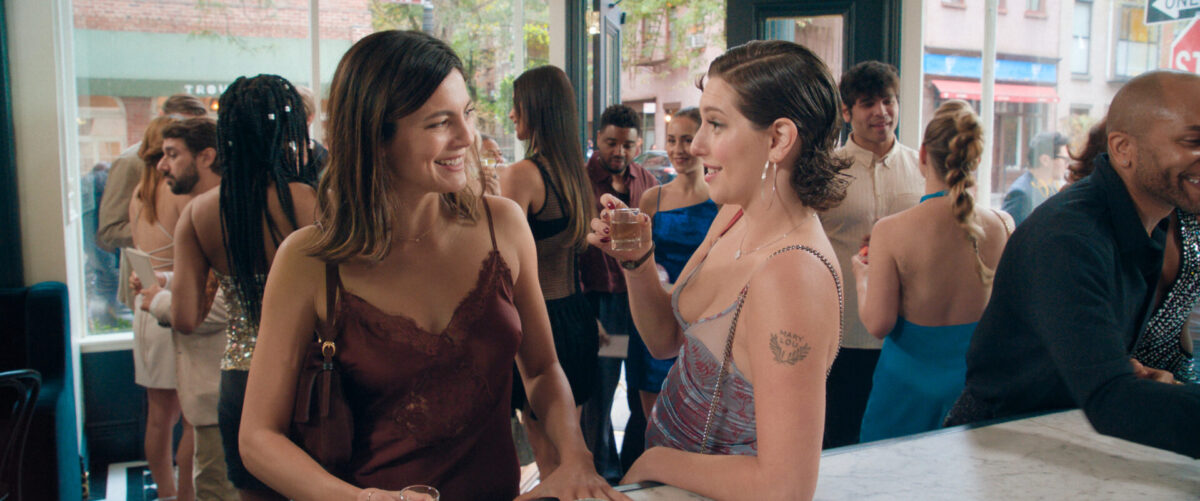
(From left) Allie (Monica Barbaro) and Jacinta (King Princess) in One Night Only, directed by Will Gluck. / Photo Credit: Universal Studios
Glock’s film hints at an undercurrent of discontent among people living in a puritanical fascist state, but it’s more in the vein of “Don’t Look at the Man Behind the Curtain.” “One Night Only” attempts to be a feel-good, live. laugh, and hook up (once a year) rom-com despite a wild mandate from the government within its word. Why would people willingly agree to this and accept this law from Congress without pushback? How would this cultivate more long-lasting monogamous relationships? In this world, sex is not only something for companies to exploit and profit from (there’s a maguffin subplot of trying to find a condom at outrageous prices), but something rationed to those who aren’t living a specific type of lifestyle.
“One Night Only” focuses on two specific characters. Allie (Monica Barbaro) is an aspiring singer who works recording jingles styled after popular songs for products to treat conditions like Psoriasis. She is determined to use the single-night mandate to avoid buying into the superficiality of the moment and to find a connection worth investing in. That hits a snag when Allie’s best friend Jacinta (King Princess) discards that notion almost immediately at a party. But Allie is determined, and the film takes her from one scenario after another in which she might meet the man of her dreams, only to be repeatedly disappointed on the most superficial day of the year.
Owen (Callum Turner) owns a pizza shop and plans to propose to his longtime girlfriend, Malika (Maya Hawke), that night. Unfortunately, she has a surprise for him. Malika has taken a liking to their landlord and plans to sleep with him instead (using their apartment, nevertheless). Understandably, Owen is dejected by this and has no choice but to partake in the sex Purge festivities himself. Writer Travis Braun gives Owen his own set of obstacles to get over, like almost paying upwards of $200 for a single condom available in the city or getting robbed by a potential hookup.

(From left) Allie (Monica Barbaro) and Owen (Callum Turner) in ONE NIGHT ONLY, directed by Will Gluck. / Universal Pictures
Within all this mayhem, Owen and Allie cross paths time and time again – the plights of their separate conquests serve as a ramp for them to naturally come together. Turner and Barbaro play off one another well enough to somewhat distract you from the film’s flashing (and ignoring) some plot tomfoolery.
For example, Allie’s roommate Arya (Quintessa Swindell) elects to stay in for the evening and babysit a wisecracking 12-year-old for $5,000. Arya is queer, and when Allie asks about her night, Arya replies the night “is for the straights.” Are queer and non-binary identifying people not allowed to partake in the pause of the chastity mandate? Also, once the “mandate” lifts, people are just going to town on subways, in front of storefront windows, and in cars with the windows open? Are indecent exposure laws suspended too?
You have to buy into “One Night Only’s” apprehension to avoid touching the preverbal hot stove of questions and contradictions it creates for itself. But in a film where sex is shrouded like gore in an action movie trying to avoid an “R” rating, Gluck is no stranger to the romantic comedy genre with 2011’s “Friends With Benefits,” 2014’s “About Last Night,” and 2023’s “Anyone But You.” He knows the formula for getting the audience to buy into his protagonists coming together. But there’s something off about this conclusion. It completely buys into all the problematic factors the world creates and concludes that premarital sex is the barrier to our happily ever afters, and we have to give up our desires and privacy along with it.
In an interview with Variety, Gluck stated that sex is a “private, intimate thing that people don’t want to see when they’re in a shared experience.” But the film itself and the many characters within it are (with feral, sometimes cartoonish verocity) motivated to do that one thing. “One Night Only” deduces that in order to combat a sensitive subject (it took upon itself to tackle), we will willingly subside into a surveillance state where pleasure is microdosed, commodified, and Sarah Bareilles’s “Brave” is remixed to sell you meds. The most damning thing is that the film assumes we are in a place where we would all accept this as our cupid-bow-and-arrow moment.