
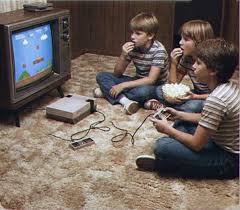
Back in the day, when you played video games with your friends, you would all sit on the couch, squint at the small and fuzzy old television, share a bag of chips, and argue about whose controller was bad. It was loud, chaotic, and physical. Fast forward to now, and that cramped living room has turned into a global online playground. Not only do we play video games now, but we also live within them, and the way we spend time together will never be the same.
Beyond the Living Room Sofa
Moving from local play to massive online worlds has transformed video games into what sociologists call the “third place.” These are spaces that aren’t home and aren’t workplaces, just like the local pub or a cosy village green where people just exist together. As communal physical spaces have become less accessible or more expensive, many people are using multiplayer video games as an alternative space to socialize and interact with others; whether they are raiding in World of Warcraft or hanging out in a lobby to show off their new World of Warcraft or Final Fantasy character skin, gaming is a social backdrop while still being a way for players to communicate.
This evolution is about our need for varied interaction. People are constantly looking for new ways to spend their downtime. Some look up online casinos for beginners to get a feel for digital cards without real-floor pressure. For others, it’s about mastering the complex economy of a space sim. The common thread is the search for an interactive environment where socialising feels natural. We’ve moved past the era where being “online” meant being isolated. Today, it’s where the party is.
Living a Life, Not Just Playing a Game
In a traditional sport, the action stops when the whistle blows. In a modern multiplayer game, the “game” often feels like it is just beginning when you log in. The rise of “Games as a Service” means these worlds are always changing, giving us reasons to keep coming back to the same digital neighbourhood. But the real glue isn’t the content patches; it is the people.
We are seeing the rise of “emergent gameplay,” where players ignore the main objectives entirely and invent their own fun. In titles like Grand Theft Auto Online or Red Dead Redemption, there are huge communities dedicated entirely to role-playing. They aren’t there to win matches; they are there to live lives. They run virtual businesses, hold mock trials, and even organise weddings. In these communities, the software is just a posh chat room. It allows for a level of self-expression that a standard text thread can’t touch.
Friendship Without Frontiers
One of the most powerful changes is how multiplayer games have smashed geographical barriers. In the past, your social circle was mostly decided by your postcode. Now, someone in Manchester can be best friends with someone in Tokyo, bonded by a shared love for a tactical shooter. These aren’t “pretend” friendships. We have all heard stories of players flying across the globe to meet their squad in person or supporting each other through real-world struggles. There is a specific kind of vulnerability that comes with gaming together. When you are under pressure in a high-stakes match, your true personality comes out. You learn who is reliable, who keeps their cool, and who has the best sense of humour.
The industry has also realised that not everyone wants to be a pro. The broadening of social entertainment means there is now space for the spectator and the casual player. Platforms like Twitch have turned gaming into a spectator sport, where watching someone play is just as valid as picking up the controller yourself. This has created a secondary layer of socialising—the live chat experience where thousands of people bond over a shared viewing experience.
Designing a World That Fits Everyone
In the future, the distinction between gaming and socialising will become even less clear. The “Metaverse” may be a buzzword, but conceptually, we will continue to interact socially in digital formats. Online multiplayer video games have expanded our social connections, as there are people around the world trying to connect on some level, through the shared enjoyment of gaming.
No longer are video game developers only trying to create experiences for players to compete and win; they’re creating experiences that people can use to connect with each other. This gives people a way to connect with one another, breaking down barriers that had previously left many people feeling socially isolated.