
The funny thing about art is that once it’s completed, it’s ageless. Whether it be poetry, a novel, a film, or a song, these works are free to inspire and challenge people for generations. The concept of fame is a bit more fickle. At least with art, you are the catalyst. Fame is fleeting, intoxicating, and crushing when the random game of chance doesn’t choose you. Ed Saxberger (Willem Dafoe) is the subject of director Kent Jones’s “Late Fame,” a once-budding poet in the late 1970’s New York culture scene who has worked in the same mailroom for 37 years. And he’s happy that way.
When we first meet Ed, there’s no longing for what could have been. He has shrunk into the Manhattan landscape, which is unrecognizable compared to the scrappy landscapes sans non-luxury SOHO storefronts of decades prior. And Ed is completely fine with that. That’s until one day, before he’s approached by an early-twenties man named Myers (Edmund Donovan) who has gotten a hold of Ed’s lone obscure poetry book. “You wrote a masterpiece. That’s forever! Myers said excitingly to his reluctant hero. Ed, while flattered, is quick to dismiss his young admirer’s excitement. Myers then lets him know that his writing group, named “The Enthusiasm Society,” loves it too, and they want to meet.
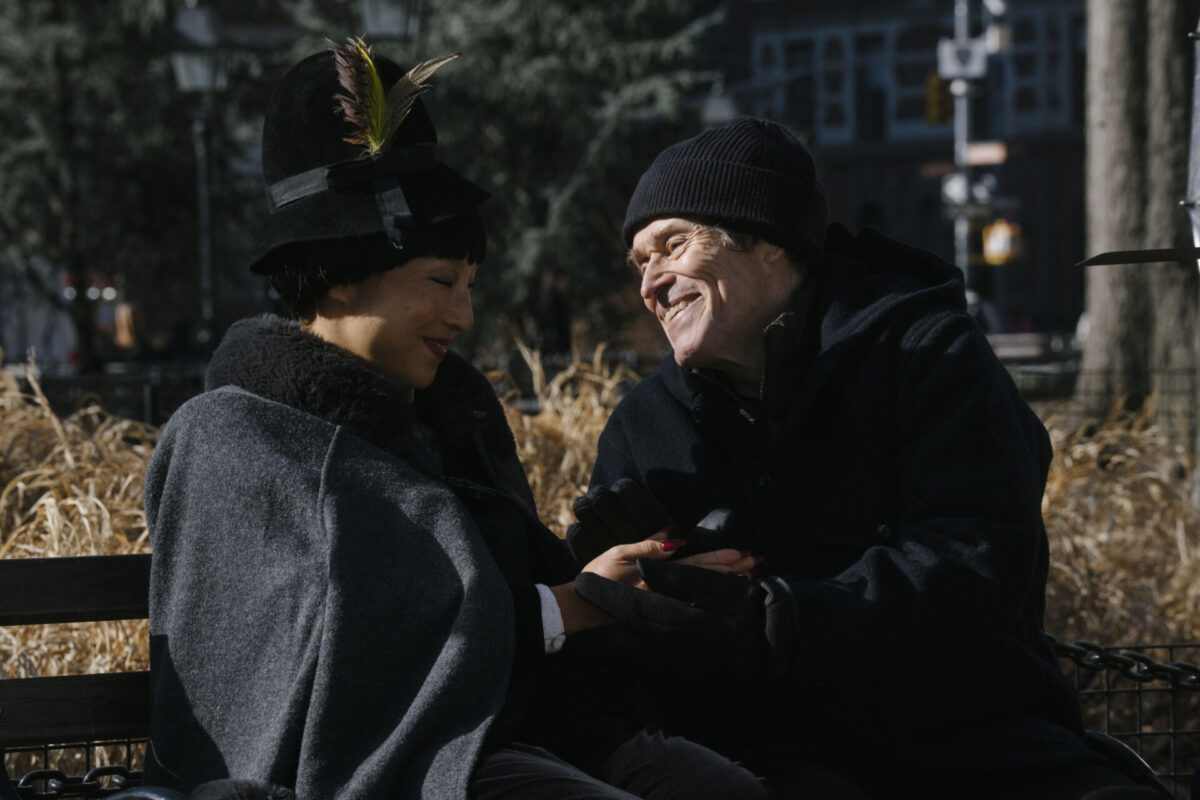
Greta Lee and Willem Dafoe in LATE FAME, a Magnolia Pictures release. Photo courtesy of
Magnolia Pictures
The small group is composed of recent college graduates—poets, playwrights, and novelists— who meet weekly at various restaurants around New York. Writer Samy Burch does something interesting by introducing intentionality in conjunction with socio-economic status. The members of “The Enthusiasm Society” are extremely well off and live in an insular world where rising rents and inflation don’t affect them in the slightest. In Myers’s posh, spacious apartment, he has a first edition of William S. Burroughs’s “Naked Lunch” on his coffee table and doesn’t even bat an eyelash. It’s at odds with Ed’s upbringing: a high school dropout who moved to New York in 1972 and just started writing.
But there’s still a real reverence for the arts, which you can see in this young group. They reject the commodification of the arts scene by social media algorithms and even, funnily, jeer at influencer culture. “The Enthusiasm Society” plans to make its grand entrance with an event featuring a series of readings. Myers asks Ed to be part of it—better yet, write something new for it. At the beginning of “Late Fame,” Dafoe’s character is surprised by the possibility that the life he wanted could be resurrected. (The film frames it not as a discovery, but a rediscovery). He’s happy to go to a local bar at night, get his trademark sandwich, and shoot some pool with his longtime buddy Arnold (Clark Johnson).

A scene from LATE FAME, a Magnolia Pictures release. Photo courtesy of Magnolia Pictures
However, Ed then starts spending more time with the group, writing again, and using the nights to take in the Manhattan landscape for inspiration. Maybe this will be his chance to realize the younger version of himself and bask in the adulation he’s been looking for. Myers seems to think so. He even goes as far as to try to set Ed up with a literary agent under the guise of writing a memoir. Dafoe’s character is not resigned to being a beacon of the “glory days” amid what he perceives as a revival of his work. Jones does something in his storytelling: he allows Ed to blend in with the current setup of New York, yet almost be alien to it, as if he were from another planet. It’s not so much from flashbacks as it’s from stories that “Late Fame’s” main character tells about his life.
“The Enthusiasm Society” constantly prods Ed’s mind, asking if they are good enough or for antidotes about the olden days for inspiration, to which Ed responds with a matter-of-fact vibe. Because in actuality, there’s a level of struggle with his writing that his newfound friends will never be able to tap into. Gloria (Greta Lee with an electric performance), a local actress with a larger-than-life aura. serves as the ultimate bridge between Ed and the other members of the writing club. Sure, there are rumors she might be dating someone within the group and is under the spell of Sunset Boulevard at times, but she’s talented. Most importantly, Gloria has to fight for the performance where she can show her brilliance. It’s something that draws Ed and Gloria closer to one another—an unspoken badge of honor.
Jones notes a couple of dividing lines within Ed’s life that he either doesn’t want to mix or reengage with. Throughout “Late Fame,” his sister calls incessantly because his brother is dying and wants to see him. Other than an inference of a falling out in the past, the audience uses the hurt in Dafoe’s demeanor to glean that this is a struggle for him. Ed also has a point of contention with Arnold and his buddies one night over him being a poet and the ribbing about it. “You wrote this?” a friend asks Ed, looking at his book. There’s an understandable irritation there, and a theme of appearances about who people expect you to be. It’s dropped with Ed and Arnold as the film slightly plays with the notion of his bar buddies coming to the reading. These guys know poetry and probably would have supported Ed, but he elects to tell Arnold not to come.
In Dafoe’s great and subtle performance, that thread is something I would have liked to be investigated a little more. Ed is thrilled about the recognition, but at the same time, he is almost put off by where it’s coming from to the point where both his worlds can’t meet in the middle. To spur inspiration, Ed plays records of other poets to get the mojo going again. But ultimately, it doesn’t occur because the verses he wrote were from a time when life was most alive for him. Ultimately, the film serves as a soft statement from Jones that creativity is not something to be extracted but to be experienced. That’s something fame can’t give you. Ed Saxberger, like other poets, not only chronicled the taste and architecture of the time but also encased it in metaphors that speak beautifully to something we yearn for. It’s better than any amount of praise or the feel of stepping on a red carpet.