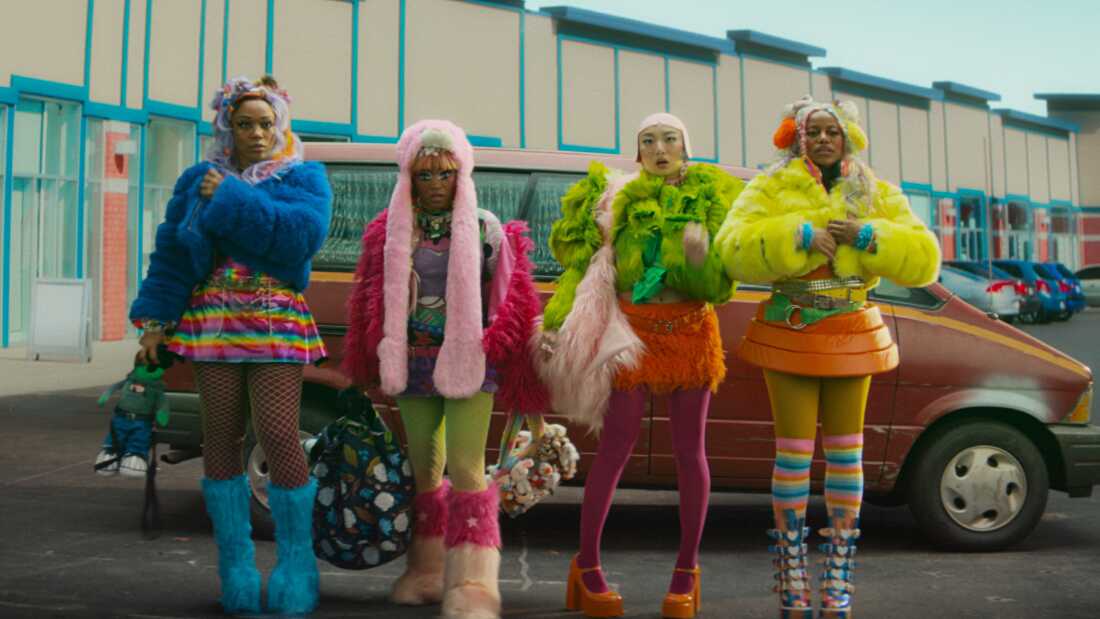
The world writer/director Boots Riley has constructed in his second feature, “I Love Boosters” — with all its hyperstylization and flair — is very much like our own. Forces are at work actively draining the life spring of art, filtering it through an algorithmic machine, and churning out uniform, shiny slop devoid of emotion or imperfection. In turn, the powerful who seek to mold the artistic process into a series of charts and graphs — feeding a savior complex they can repackage it as hope and dreams. That tension is a microcosm of the broader socioeconomic squeeze between the rich and the poor, and who gets to indulge in the finer things in life.
Riley touches on all of it in an energetic, imaginative satire that chronicles how revolutionary movements start small, are intentionally split apart, and can coalesce around a single goal that benefits all. Corvette (Keke Palmer) is an aspiring fashion designer, but her economic situation isn’t the greatest. She’s resigned to living in an abandoned chicken fast-food restaurant, hoping for a better life. (The film depicts her anxiety as a literal boulder of problems). Palmer’s character is a part of the “Velvet Gang” with her friends Sade (Naomi Ackie) and Mariah (Taylour Paige). True to the booster credo, they steal high-end fashion clothes and sell them at discounted prices to their communities that can’t afford them. Mariah calls it the three F’s, “fashion forward philanthropy.” (She knows there are only two F’s, but it works!)
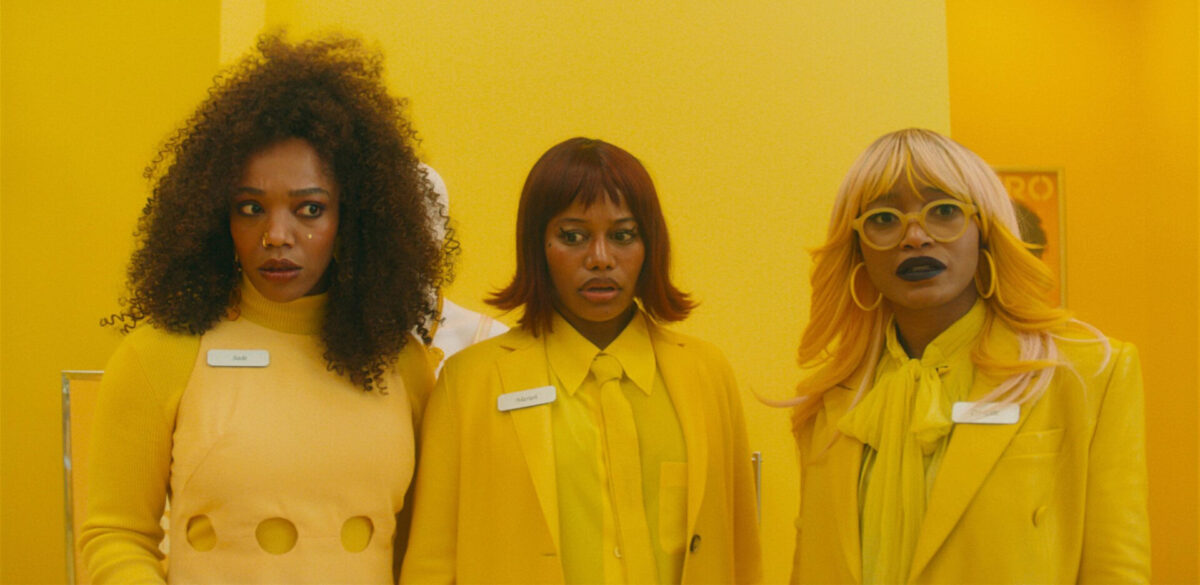
Photo Credit: Neon Pictures
The direction of their Robin Hood-esque ire is a high-end fashionista named Christie Smith (Demi Moore). Smith is the head of Metro Designers, whose stores are filled with monochrome colored clothes. Smith lives in a luxury high-rise that’s on a slant and exudes self-importance. She likens her clothing to a way of “bettering the world” because that’s the only viable canvas. Smith is also part of a democratic think tank, yet she does not elect to pay her boutique or factory workers fair wages. Not to mention, the fashion executive uses racially demeaning language when talking about the Velvet Gang.
Riley has a lot to say in “I Love Boosters,” almost to the point where it feels as though the film will rupture from all its ideas. News broadcasts with random citizens decrying the unions and rent-controlled housing happen throughout the beginning and middle of the runtime. There’s commentary on pyramid schemes through Sade’s character and how they prey on underserved communities, masquerading as a way out. But Corvette’s inner and outer struggles are central to the film’s message. The idea of Christie Smith as a woman who has risen through the ranks in the fashion industry aligns with Corvette’s direction. On the surface, Christie’s ascent is inspirational. But the racial and economic impediments to her situation are too hard to ignore. That anxiety results in a lack of recollection that the community she seeks is right in front of her.
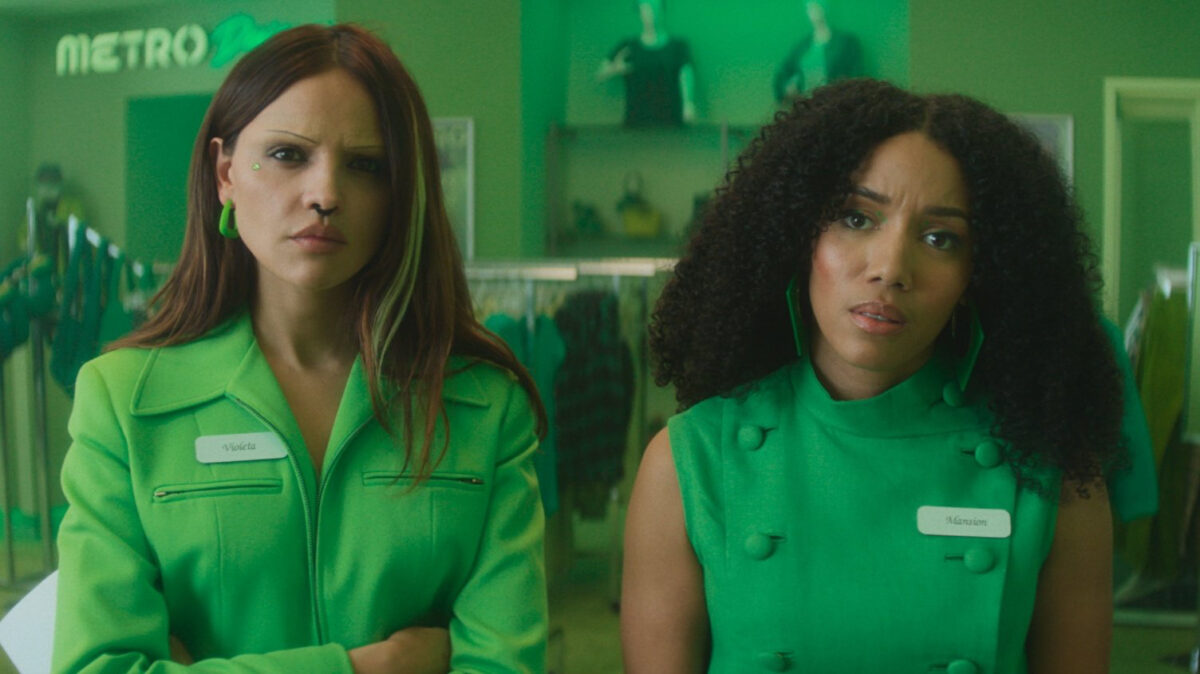
Photo Credit: Neon Pictures
“I Love Boosters” builds on the premise that elites intentionally fracture the collective into distinct characters. Sade has children, so she is looking for the best possible way to provide for them. That, at times, comes at odds with Corvette’s personal mission. Jianhu (Poppy Liu), a factory worker from China striving to improve the awful conditions at her workplace, introduces a futuristic element to the group that warrants attention. Violeta (Eiza Gonzalez), an intelligent stoner and underpaid worker at one of the Metro locations, wants to unionize for better pay. She’s the conduit for the exposition regarding a sci-fi device that comes into play – another tool in Riley’s idea bank to accentuate the contradictory existence we live in. Palmer’s ability to display a wide range of emotions is key in holding the many elements of theme together, but Ackie, Liu, Paige, Moore, and Gonzalez all add different flavors to the pot. It’s meaningful to see a cohort of women of color help the society within this film reach a level of class consciousness.
Riley’s film, on its surface, is a battle of an aspiring artist and the avatar of the corporatization of that spark – both from the writer/director’s own mad dash implementation of panache and the characters themselves. For example, Corvette’s color is turquoise, but Christie adds, “No, that’s aqua marine.” “I Love Boosters” includes subtle and obvious examples of how culture in minority communities is sapped and outsourced without any flavor. But Riley’s film is most effective when the competing ideas of liberation comes together. Individualism and capitalism work together to serve the same purpose – isolation and consumption. But what could we accomplish if we worked together towards the greater good?
Natasha Braier helps bring out an almost cartoonish world filled with intense color and camera techniques that, in some respects, shrink problems down to an individual level. There’s stop-motion, miniatures, and even elements of body horror. It’s as if Riley’s ultimate middle finger is how originalism and passion will always trump how someone from the outside would utilize it. Can it be overwhelming at times? Yes. But you can’t help but respect the unique way “I Love Boosters” approaches its call for workers’ rights and its rejection of the current system. A funny, albeit a definite outlier, is a potential love story between Corvette and LaKeith Stanfield’s character (which I will not spoil). The score set by the eclectic duo Tune-Yards adds a polka, brass-band feel that moves things along.
Timely is a descriptor that I feel we use a lot, but there’s no getting around how of-the-moment “I Love Boosters” is. The cost of food, gasoline, and housing is rising, while wages are barely keeping up. People are working multiple jobs (if they can get one) to make ends meet. The demands of a capitalist society pull its levers, leaving people too tired and dejected to organize and act. And then there is art. The AI-ification of music, photographs, film, etc., seeks to remove the rewarding process of trial and error from the work. Instead, the rich and powerful hide behind the smokescreen of “democratization” to mask their inefficiencies in a medium that requires soul and lived experience.
A character in “I Love Boosters” says, “People don’t want to be the art, they want to be the artist.” Riley’s new film speaks to the masses, weary and dejected about being specks of paint on the canvas of the powerful, and want to take the paintbrush back.