
Benny Safdie knows exactly the cadence you’re expecting when walking into a sports biopic. To his credit, he at least tries to disrupt the formula and compose something fresh in “The Smashing Machine,” based on the life of former mixed martial arts titan Mark Kerr. Even with the unconventional storytelling method and the quadrants it looks to place its hallmarks in, there are still benchmarks you’d recognize. There’s the rise of the superstar and soon after, the dizzying fall. After the taste of immortality turns bitter, it’s the climb back upward we root for and the complications that follow. Sometimes, it’s messy. Oftentimes, it’s complicated; yet exhilarating nevertheless.
The writer/director finds a steady force in Dwayne (The Rock) Johnson, who portrays the fighter both in terms of physical stature and emotional restraint. The film focused on a particular part of Kerr’s life, from 1997 to 2003, during which a stint fighting in Brazil would lead the one-time undefeated fighter to the Ultimate Fighting Championship and then the Pride Fighting Championship in Japan. Amidst this abundance of acclaim, Kerr fights through a substance abuse problem, strife with his then-partner Dawn Staples (Emily Blunt), and tries to beat back the essence of vulnerability. (it catches up with all fighters or athletes, of that matter).

Dwayne “The Rock” Johnson and Emily Blunt in “The Smashing Machine” / Photo Credit: A24
One scene in particular highlights why Johnson is so effective in this role, and perhaps a missed opportunity in the script, which sometimes ventures too far in so many directions. A reporter speaks to Kerr and asks him if he has ever contemplated losing before, and it rattles him. It’s the way that Johnson delivers the answer, which is so forceful and indirectly sets the course for the film. There’s a particular belief in invincibility that comes with being an athlete – it goes double for being a 6’3 “, 250-pound force of destruction. He even explains about the cerebral aspects of “asserting your will” onto an opponent and them not being able to do anything about it.
Even though Kerr’s “first loss” was overturned for illegal knee strikes, it derailed him. Safdie’s film somewhat gives Johnson space to explore that. However, there are too many things “The Smashing Machine” wants to be. Does it want to be a relationship drama? Johnson and Blunt work as the often combative couple, but “The Smashing Machine” encases Mark and Dawn’s relationships into circular arguments. Mark has a defined routine for approaching life, and the film makes it clear that Dawn disrupts it. “The Smashing Machine” also has Dawn declare on numerous occasions that Mark keeps her emotionally at a distance. Other than what they express on the surface, and the explosive scenes the characters have together, there’s no real insight into how their relationship evolved.
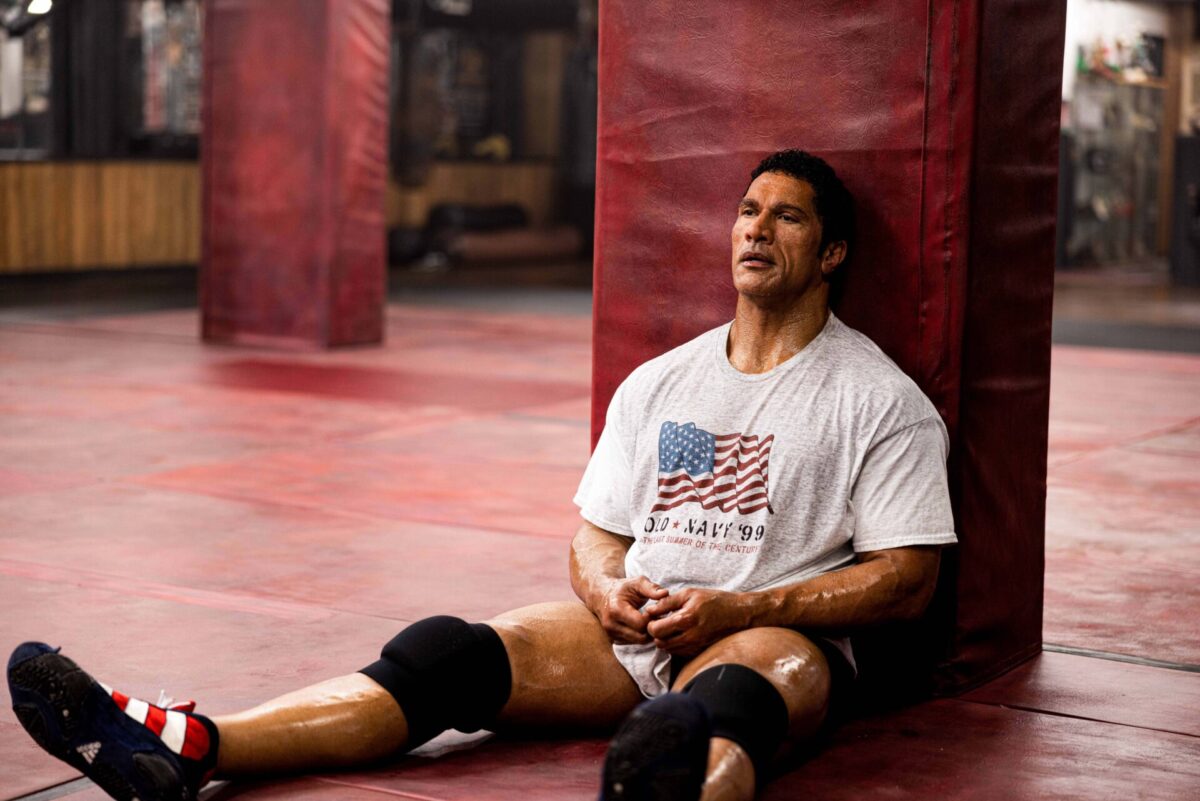
Dwayne “The Rock Johnson as Mark Kerr in “The Smashing Machine” / Photo Credit: A24
Is “The Smashing Machine” a pseudo-friendship/brothers-in-arms story? Partly. As Kerr’s world begins to tumble, the film picks up the story with his trainer, Mark Coleman (Ryan Bader). The story also serves as a separate redemptive arc.. At the moment when Kerr takes a brief exit to rehab, Coleman’s “battling against the hands of time” segway begins. While there’s a feel-good aspect to it, the perception shift shows the audience much of what they are missing. For starters, there doesn’t seem to be a desire to delve into Kerr’s insights on addiction beyond the surface level. With the subtlety in Johnson’s portrayal of Kerr, we can infer there’s a physical toll that is enacted as these fights go on. Yet, “The Smashing Machine” doesn’t take a beat and puts those to light beyond the ring.
It also shows itself in a particular scene with Kerr’s trainer, Bas Rutten (playing himself). It feels as if the film wants to make an overall argument about the cost of headlocks, illegal knees to the head, and chokes, but it doesn’t go far enough. With Kerr and Coleman’s relationship, “The Smashing Machine” depicts them as two people standing on escalators moving in different directions. Given what the film reveals about Kerr’s mental state, there’s little investment in navigating his friend and training partner reaching a height he never achieved.
While impressed by Johnson’s performance, you can’t help but wonder if there was more to be learned about Kerr himself. “The Smashing Machine” manages to cover a lot of ground and keep its subject at a distance simultaneously. You know the broad strokes and events of what Mark Kerr has gone through, but wonder if time could have been spent diving into more of what personality made him stand above the rest.
This review is a part of Substream Magazine’s 2025 TIFF Coverage