Thanks to the “Terminator” franchise, “SKYNET has become self-aware” has engratiated itself within our pop culture lexicon. The Sci-fi series envisioned a cataclysmic future in which a supreme artificial intelligence, with robot avatars, has reduced human civilization to rubble. Well, the future is now the present. We don’t have T-1000 armed with machine guns roaming the streets; AI (for better or worse) has been implanted into our everyday lives.
It’s at the forefront of writer/director William Woods’ mind with “The Outer Threat,” a sci-fi thriller blended with family-drama elements. There’s a genuine question at play, given humanity’s thirst for knowledge and its tendency to lead us to our own ruin. In this case, it’s better left as something for the film’s small family of four to discover. But there’s an inherent tenseness Woods’s film is hoping to invoke in the viewer that falls short – whether it be integrating elements from end-of-the-world dystopian films, which felt more dire, or not giving the viewer an understanding of the world they live in. If I don’t get some background on what’s at stake (other than a broad totality of civilization), then I can’t sink into what I’m losing.
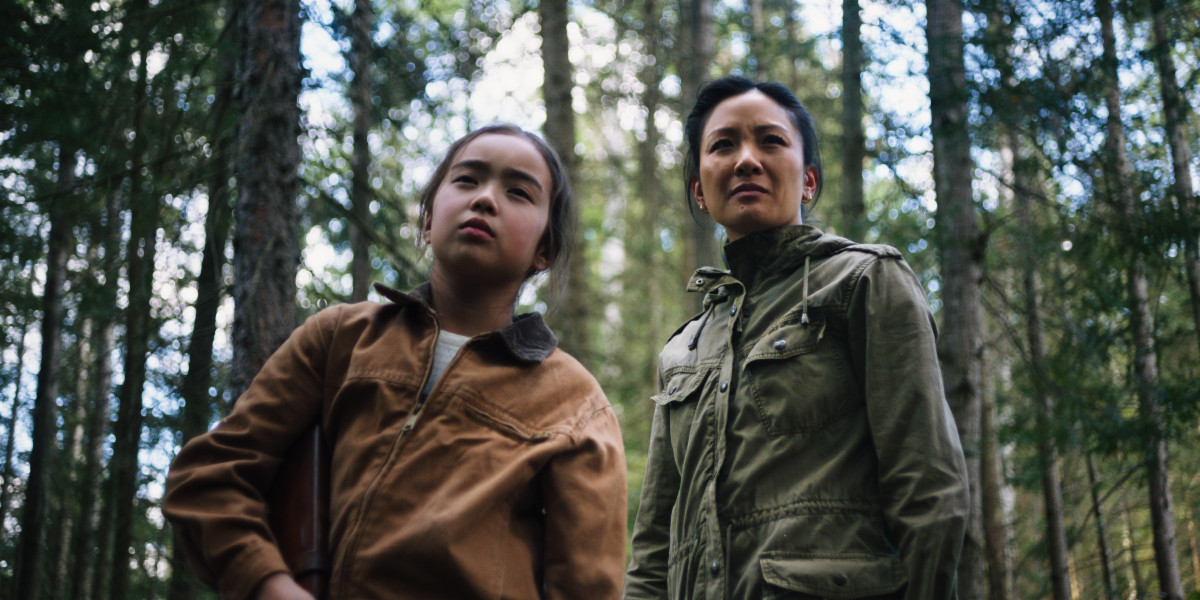
Michelle (Constance Wu) and Daniel (Mark O Brien) are astrophysicists who live in a large compound with their two children, Francois (Isaac Smelcer-Zhang) and Maddie (Callista Crowe), and are homeschooled. Michelle states it’s because she doesn’t want them “growing up the same way” they did. She resigns herself to teaching Maddie how to hunt. Right from the start, the film conveys a sense of society crumbling, though it does not fully explain how that happens. These kids are extremely intelligent. Is it because of devices or rough neighborhoods? We don’t know.
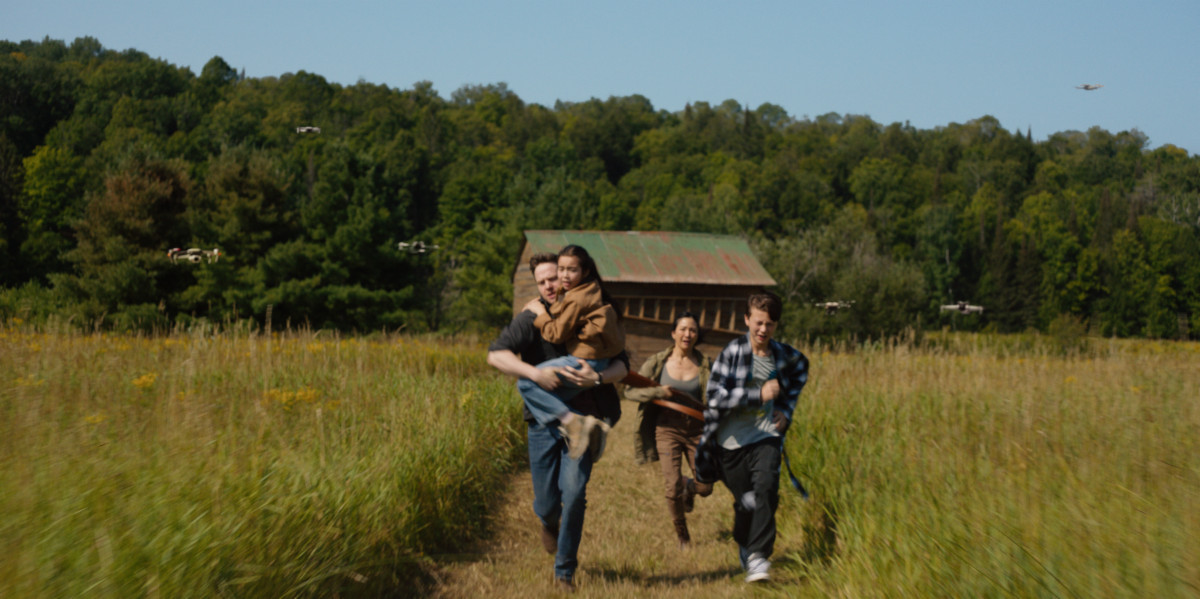
“The Outer Threat” / Photo Credit:” Quiver Distribution
Daniel has been researching something for years – that perhaps there is life on other planets. His government contact, Ted (Murray Furrow), doesn’t want to hear this. At first, Michelle is dismissive of it as well. Daniel’s workaholic personality reminds her of why she and her father (Oscar Hsu) are estranged. But he knows he’s on the precipice of discovering something life-altering. While Michelle affirms that, she cautions Daniel against sharing his findings with anyone. Think about the whole parable of potentially bringing about a disastrous end to humankind.
Well, Daniel doesn’t listen, and soon a swath of drones descends upon the family’s house. Not to mention, the internet and cell phone service are down. The family has to make their escape, but what exactly is causing the world to plunge into madness? Is it aliens? Is it something else? Woods’ attempts to construct a picture of things quickly falling by the wayside through a character the family meets, Sam (William Fitchner), one of the few other characters we meet in “The Outer Threat.” His inclusion is supposed to imply what we know from world-ending stories like this one: humans will default to survival tactics rather than work together. It’s a lesson that is poignant, but not as well deployed in this story.
Other than some offhand comments about soldiers telling people to shelter in place, we don’t have any idea what the general population is going through in this crisis. It’s all localized to this one family and the small population of people they encounter on their journey. The establishment of time and the stakes keep fluctuating, but it’s clear this smart ensemble is going to move one step ahead of them eventually. With Wu and O’Brien’s characters, they try their best to be responsible parents, hoping there’s a future for their children to live in. Later in “The Outer Threat,” they become two competing avatars for the way forward in terms of how they want to save the world and what happens after.
The problem with that is in the formulation of how they propose to do so. It’s so far-fetched and distant that the eventual solution undercuts it. Unfortunately, most of us would be fodder for the antagonist in Woods’ film, but not for the family inside the story. Other than a couple of high-speed car chases, they put their heads together and solve problems a little too easily. Maybe it’s because this foursome lives outside of the confines of conventional life to tap into the ingenuity not distilled by digital dopamine hits. I ask myself what we’re capable of if we untangle ourselves from our digital masters daily, as Woods does. “The Outer Threat” eventually poses that question to everyone. But the journey might be too simplistic and less thrilling than we would hope.