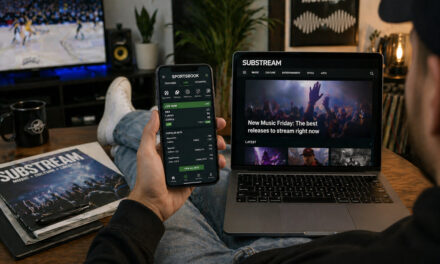
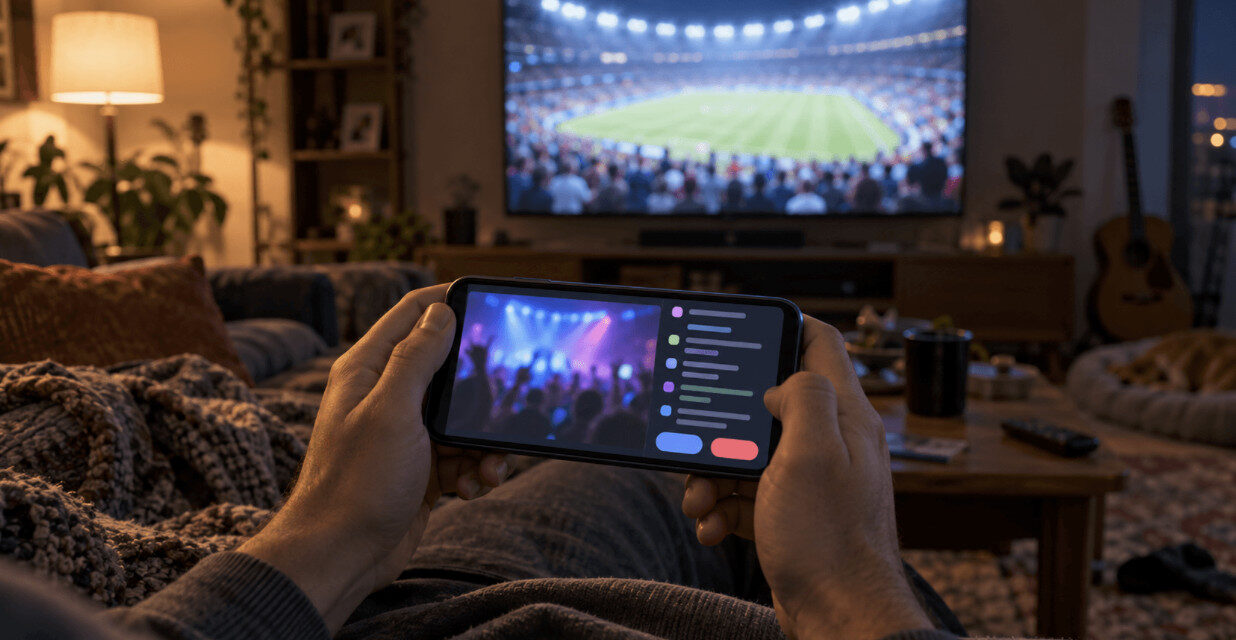
Super Bowl LX pulled 125.6 million viewers in February, and Nielsen’s final count made it the second most-watched Super Bowl ever. Television sport isn’t dying. What’s changing is what a fan does while the game is on. For a growing slice of people under thirty, the answer is a live stream with a chat window and a co-streamer talking over the feed. Plus a prediction on the next round. That’s the shape of fandom TV never offered.
The couch is still there. The remote’s been replaced by a phone.
Two kinds of fan, side by side
Lay the two experiences next to each other and the difference isn’t the sport. It’s the posture. Strafe’s esports betting guide, where you can read more on how bookmakers put the stream and the odds on one screen, describes the right-hand column below almost feature for feature.
| TV sports fandom | Live-stream esports fandom | |
|---|---|---|
| Where you watch | Broadcast or cable, one feed | Twitch, YouTube, TikTok, often a co-stream |
| Who’s talking | The network’s commentary team | A creator you chose, plus the chat |
| What you do during play | Watch | Predict, vote, argue in chat, hold a position |
| Second screen | Optional | Assumed |
| When it’s over | Final whistle | When the deciding map ends, then the post-match stream |
The right-hand column is the one growing, and the demographic data shows why.
The generation that opted out of TV sport
Morning Consult surveyed Gen Z sports habits and the picture, as Sports Handle summarised it, was blunt. Only 53% of Gen Z respondents called themselves sports fans, against 63% of US adults and 69% of millennials. Nearly two in five said they never watch live sport at all.
Esports was the exception. 35% of Gen Z identified as casual or avid esports fans, roughly double the figure for adults overall. The same cohort that’s half as likely as millennials to watch live sport every week is twice as likely as adults overall to call itself an esports fan. That fits a generation that, as Substream noted this month, tends to turn its hobbies into identity rather than keep them private.
That survey is six years old now. The viewership numbers since then point the same way. In H1 2026, Esports Charts logged a peak of 5.68 million concurrent viewers for the Mobile Legends M7 World Championship. The IEM Cologne Major in Counter-Strike hit 2.75 million, and League of Legends’ LCK Road to MSI 2.27 million. Cologne also became the first Counter-Strike event to pass 100 million hours watched. Esports Charts found that “independent broadcasts generated close to half of both the tournament’s total watch time and its peak audience”.
Those are streams, not broadcasts. Nobody scheduled them around a network’s evening slot.
Where the prediction layer comes in
A live stream on its own is still passive. What tips it into something else is the layer of questions sitting on top of it.
Some of that is free. Twitch’s built-in Predictions let a streamer pose a question and viewers stake Channel Points on an outcome, with the winners splitting the pool. Some of it is paid, on real-money betting sites where the same question carries real odds. Strafe’s guide notes that a number of those sites embed the live stream directly on the betting page, so the feed and the market sit in one window. Either way, the viewer’s no longer just receiving the match. They’ve got a stake in the next two minutes of it.
The reasons that layer stuck are specific:
- Esports matches are built from short, discrete events. A pistol round, a map, a first tower. Each one is a question with a fast answer, which is exactly what a prediction needs.
- The audience is already on a device. There’s no second screen to reach for when the first screen is a phone.
- Chat makes a prediction social. Being right in front of ten thousand people is a different feeling from being right alone on a sofa.
- Co-streamers run the room. A creator can open a prediction, react to the result and keep the audience through a timeout, which a network broadcast can’t do.
None of that works as well on a 90-minute football match with one scoreline, and that’s part of why TV sport has been slower to copy it.
Replacing is the wrong word, and the right one
Be careful with the headline claim. The Super Bowl number is real, and no esports event is within a mile of it on a single feed. TV sport isn’t being replaced in the sense of disappearing.
It’s being replaced as the default model of what fandom looks like for the people coming up behind. A twenty-two-year-old who’s spent a decade predicting rounds in chat isn’t going to sit still for three hours of broadcast with nothing to do. The networks know it, which is why alternate feeds, creator casts and in-app polls keep showing up on traditional sport too. The stream didn’t beat the broadcast. It rewrote the job description, and the broadcast is now applying for it.