
Nobody picks up a guitar and plays clean notes on the first day. There’s a gap between wanting to play and actually knowing where to start, and for most beginners, that gap feels wider than it should. Tab helps close it. It’s one of the most practical tools you’ll find as a new player, and getting comfortable with it early saves a lot of frustration down the road.
What Tab Actually Shows You
Think of the tab as a picture of the guitar neck laid flat on paper: six horizontal lines, each one representing a string. The bottom line is your thickest string, the low E. The top line is the thinnest, the high E. It maps directly to how the guitar sits when you look down at it while playing.
For anyone just getting started and wondering what is guitar tablature, here’s the core of it: it’s a notation system that shows you exactly where to put your fingers on the fretboard, no knowledge of sheet music required. Numbers on each line tell you which fret to press. A zero means the string plays open, unfretted. That’s really the whole foundation.
How to Read the Numbers
Each number points to a fret on a specific string. A 3 on the bottom line means press the third fret on the low E. A 5 on the second line from the bottom puts you on the fifth fret of the A string. Read left to right, same as text.
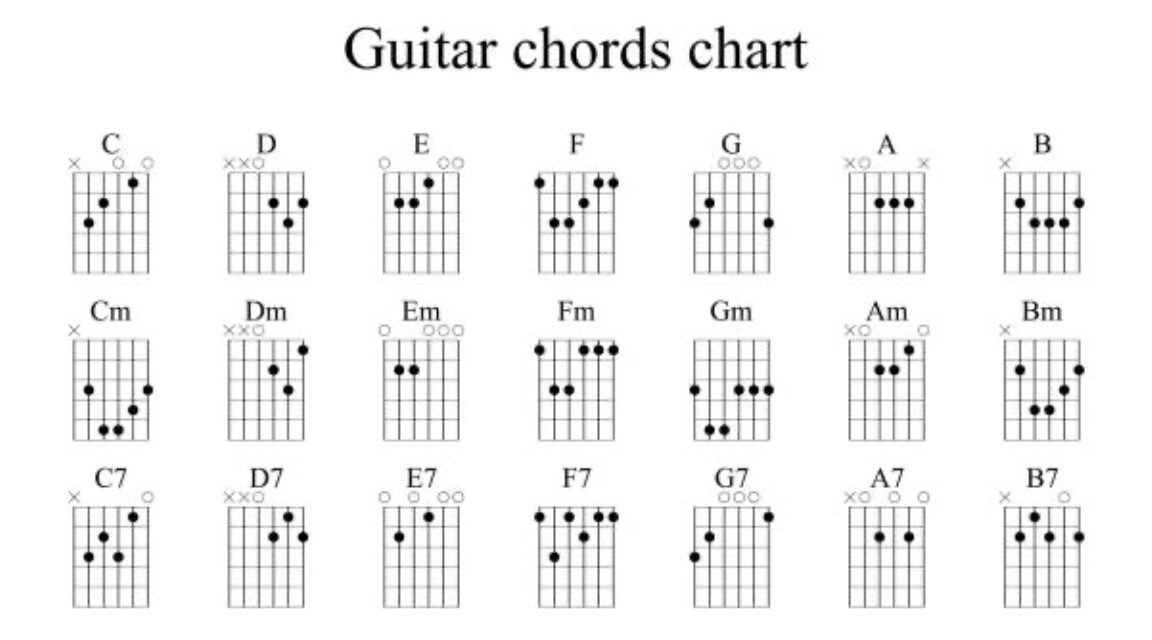
When numbers appear stacked on top of each other, play them simultaneously. That’s a chord or an interval. When they run in sequence horizontally, you’re playing a melody or a riff, one note at a time. An open G chord in tab looks like this:
e|—3—|
B|—3—|
G|—0—|
D|—0—|
A|—2—|
E|—3—|
After a few practice sessions, this starts to look less like code and more like a map.
Symbols You Will Encounter
Numbers only tell part of the story. Tablature also uses symbols to show technique, and technique is what makes notes sound like music rather than a sequence of plucked strings.
Hammer-ons and Pull-offs
A hammer-on appears as h between two numbers, like 5h7. Pick the fifth fret, then drive your finger onto the seventh without picking again. The note rings from the motion itself. A pull-off reverses that: “7p5” means you play the seventh fret, then snap your finger off to let the fifth fret sound. Both techniques are everywhere in rock, blues, and fingerstyle playing.
Bends
Bends use the letter b, usually with a target fret after it. The notation “7b9” tells you to pick the seventh fret and push the string upward until it pitches to what the ninth fret would normally sound like. Half bends, full bends, and release bends appear in the standard tab. Worth spending time on these; bends are how guitarists add expression that no chord shape can replicate.
Slides
A forward slash (/) means slide up, and a backslash (\) means slide down. So 5/7 tells you to pick the fifth fret and slide your finger up to the seventh. Slides show up constantly in the blues and rock tabs once you know what to look for.
Tips for Practicing With Tab
Reading tab and playing it cleanly are not the same skill. Most beginners can decode the notation fine, but then stumble when it comes to executing it in real time. The gap lives in the hands, not the head.
Slow down more than you feel comfortable. Accuracy comes before speed, and that order matters more than most beginners expect. A metronome set well below performance tempo isn’t a beginner crutch; it’s how muscle memory gets built the first time.
Work in short phrases. Tabs are usually divided into sections, verses, choruses, and transitions. Pick one small chunk, repeat it until it no longer requires active thought, then move to the next. That approach compounds faster than trying to run through the whole song on repeat.
Here’s the thing: a lot of players skip listening. Keep the original recording nearby and check your phrases against it constantly. Your ear will catch wrong notes before your eyes do. Tab also has a well-known weakness around rhythm; spacing between numbers doesn’t always convey timing accurately. The audio fills that gap.
Building a Foundation That Sticks
Tab won’t teach you everything. It doesn’t cover theory, it’s imprecise about rhythm, and it can become a crutch if you never push past it. But as an entry point? It’s hard to beat. It puts your attention on the fretboard where it belongs, and it gets you playing real music faster than most methods.
Start with melodies before full songs. Get your fretting hand clean and your tempo honest. The players who progress quickly aren’t the ones who learn the most songs. They’re the ones who build clean habits early and let everything else grow from that base.