
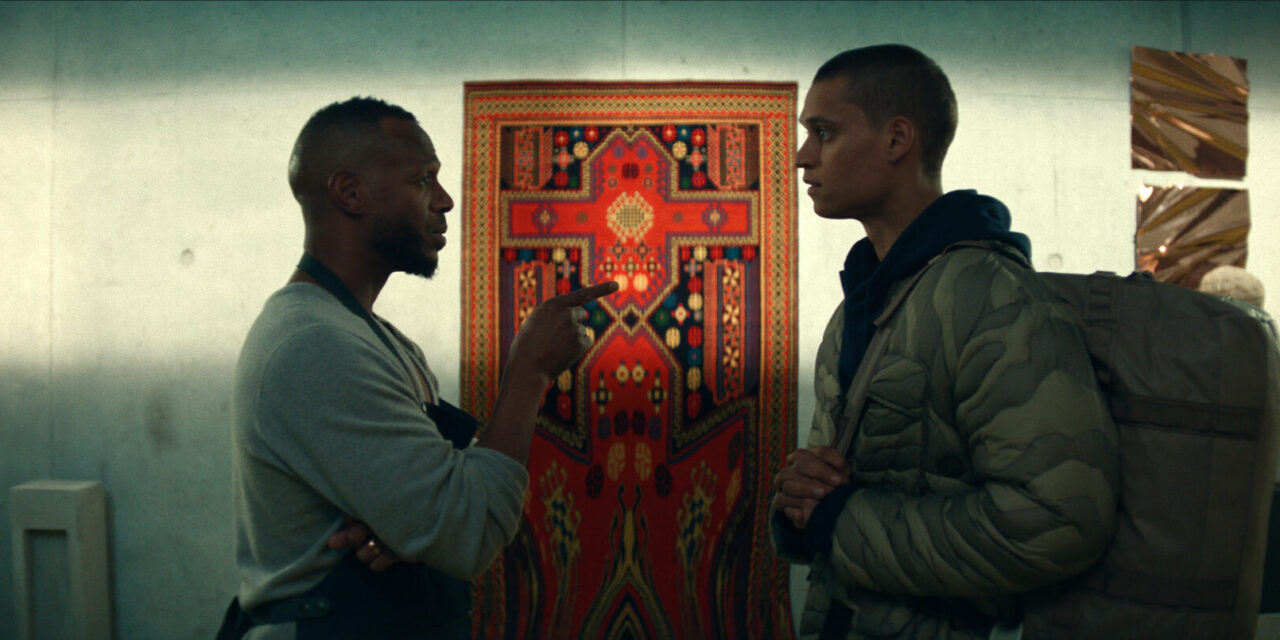
Long before the Roy family battled and schemed for control of Waystar RoyCo on Sunday nights, succession has been a consistent occurrence in sports. More specifically, with the quarterback position in football. The tension between Joe Montana and Steve Young’s San Francisco 49ers in the 1990s and Brett Favre and Aaron Rodgers’ stop-and-start fiasco with the Green Bay Packers in the mid-2000s are examples of the tension between old and new. Careers don’t last forever, but the intoxication of power when it comes to being the most important player on a team doesn’t dissipate efficiently (if at all).
Jordan Tipping’s “Him” feels as though it’s most interested in investigating its very own “out with the old, in with the new” joust between a star approaching the twilight of his playing days and the air apparent on the rise, but doesn’t quite know which angle to take. There are many intriguing prospects for the story that are left dangling and even abandoned altogether because the film elects for the abstract when it could have been more definitive. Isaiah White (Marlon Wayans), quarterback for the fictional San Antonio Saviors, is this world’s Tom Brady – arguably the greatest player ever to lace up a pair of cleats.
During a particular game, a young Cam Cade watches intently as a makeshift shrine to the team itself is briefly shown in the background of his family’s living room. His father (Don Benjamin) is absolutely intent on his young son being the successor to White’s throne one day. While a horrific leg injury happens to the legendary quarterback, Cam’s father makes sure he watches. “No pain, no gain!” he says, while insisting, “that’s what a real man looks like,” as White grimaces in pain.
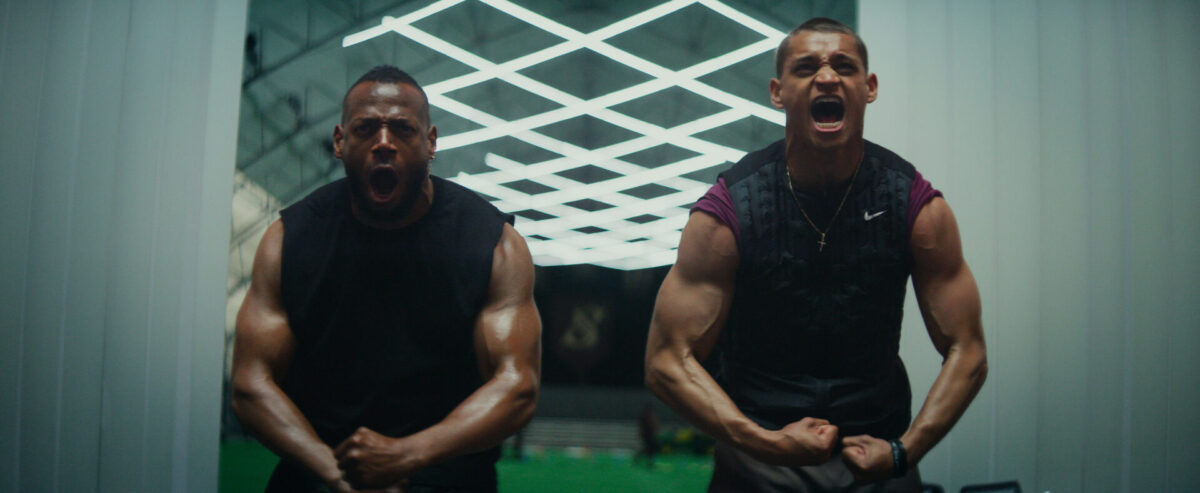
(from left) Isaiah White (Marlon Wayans) and Cameron Cade (Tyriq Withers) in HIM, directed by Justin Tipping.
White would make a miraculous recovery and go on to win eight championships and be regarded as “The G.O.A.T.” Him’s story intro, co-written by Tipping, Skip Bronkie, and Zack Akers, gives a good basis for where things can do. Football, in essence, molds young men’s view of masculinity, and the sport is basically enshrined as if it were a religion. However, the promise of fame and notoriety demands a great deal from you. That aesthetic continues as Cam (played by Tyriq Withers) grows up and is the number one-touted prospect in the upcoming draft. He’s got all the tools to be the next up, but something weird happens during Cam’s night practices. The greatest in training is attacked by a mascot out of nowhere, and that leaves him with staples and probably a concussion.
At that point, his hopes of wowing interested teams during the weekend are thwarted, but a second chance comes around. It just so happens that White extends an invitation for Cade to train with him for a week. If the young up-and-comer does enough to impress the incumbent, it’s more likely than not that he will be the “savior” to the Saviors after White makes his exit. “Him” sets up a rather simplistic story where the seemingly content, but apprehensive veteran has to train the person set up to take his place. However, the film complicates things with sporadic instances of pagan imagery and symbolism that suggest something else may be behind White’s longevity.

Tyriq Withers is Cam in HIM, directed by Justin Tipping
The thing is, the film indicates White is still on top of his game. So, why is he in a rush to retire and (reluctantly) ready to give the mantle over to the young, hungry Cade? “Him” plays coy with that notion – instead relying on a frantic, enjoyable Wayans performance to bring it home. Beyond that, it becomes difficult to determine the legend’s motivation in particular. If he wants to be an icon, he’s that and then some. If it’s to show Cade the ropes, he doesn’t necessarily have to. So, what does this “American Horror Story”-like bootcamp really intend to show us past themes the audience might be familiar with already?
To fully show the “cost of being great,” Kira Kelly’s cinematography elects for x-ray vision to show how impactful hits and injuries are. It’s reminiscent of 2005’s “Blitz: The League” and the newest “Mortal Kombat” installments. While jarring in the beginning, the shots lose their muster because you’ve gathered what the film is saying by the third one. Cade is mainly on the receiving end of brutal tackles, drills, and blows to his emotional psyche. The damage is blunted by Isaiah’s trainer (Jim Jefferies), or at least that’s what’s inferred by the vials of “pain killers” he gives Cage. Are these serums giving the young quarterback supernatural powers? “Him” doesn’t really feel the need to provide context for much of what is happening. It leaves Withers in a state of suspension, walking into one haunted vigil after another.
When discussing what the film aims to accomplish, it would be fitting to examine its marketing strategy, as the words “executive produced by Jordan Peele” were very much billed as a draw. With that, there are certain expectations an audience will have as they remember the now often-inimitated 2017’s “Get Out.” It’s not fair to Peele; he just made a great film. “Him” finds itself trapped in the Peele-ification of cinema, invoking elements of his visual style and satirical views on society without understanding why they were effective in the first place.
“Him” does a roundabout look at the somewhat unhealthy relationship where fans elevate athletes as deities and predominantly white ownership views Black star athletes as cattle for sport. However, the message is both overt and insufficient at the same time. Ultimately, you are left with a confusing 14-play drive that fails to result in a touchdown, the film’s ultimate goal.