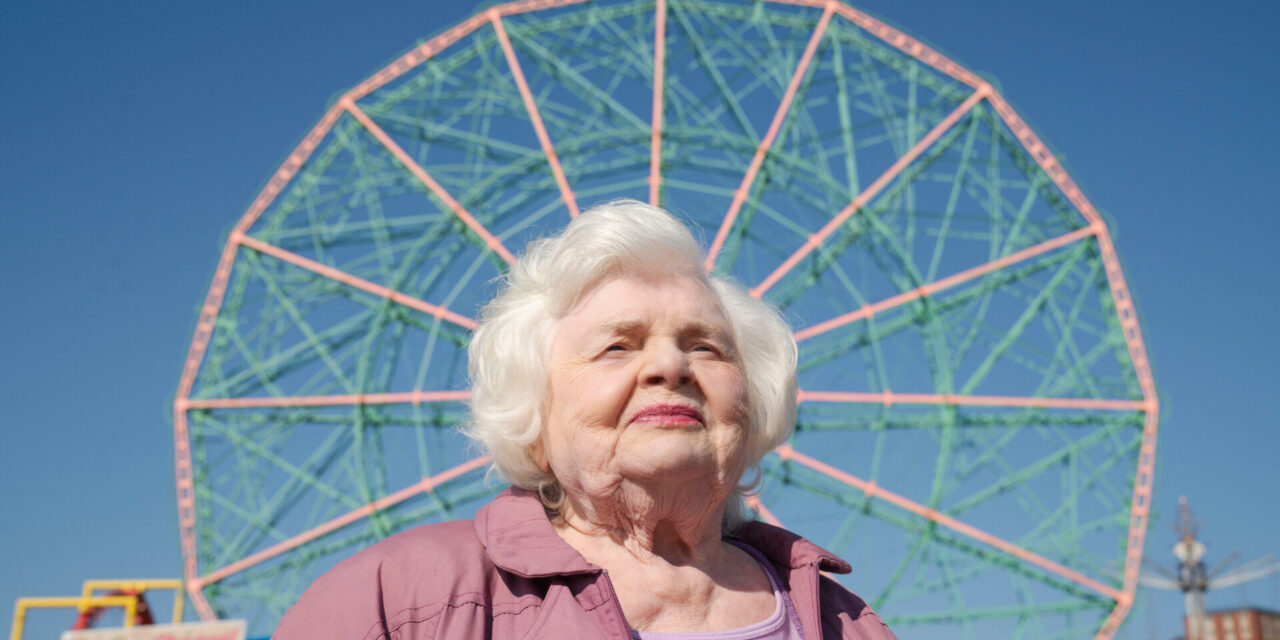
We indeed have to keep the stories of the past alive to learn from them truly. But what happens if that same story is a little too complex and much too heavy for us to tell alone after someone is gone? Scarlett Johansson’s directorial debut, “Eleanor The Great,” strives to make an earnest bridge between a sweet generational comedy while tackling a heavy subject. While the film means well in its exploration of the importance of history, the premise proves to be a bit too weighty for the great performances to carry on their own.
Eleanor Morgenstein (June Squibb) and her long-time best friend Bessie (Rita Zohar) live together in a beautifully settled apartment near the Florida beach. They have a synchronized routine where they go for a walk every day, tell stories, and even make a young grocery store clerk work hard on a particular task. You have to keep those young folks in line! Even with the good times, Bessie still has nightmares about the past as she is a holocaust survivor. In some of the most effective scenes throughout the film, she emotionally recounts the stories of the atrocities she witnessed in her youth while Eleanor looks on.
Unfortunately, tragedy strikes, and Bessie passes away. It is after that moment that Eleanor decides to leave Florida and move in with her daughter, Lisa (Jessica Hecht), and grandson, Max (Will Price), in New York. They have lives of their own and mostly leave Eleanor to her own devices. In trying to cope with the grief of losing her best friend and rejecting her daughter’s advances of being put in a living facility, she stumbles upon a holocaust survivor group. Eleanor assumes Bessie’s story as her own.
If that wasn’t dicey enough, Eleanor meets budding college journalist Nina (Erin Kellyman), who wants to write about Eleanor’s supposed “true” story. Nina has experienced loss in her own right, mourning the death of her mother due to a tragic accident. In that mode of sadness, she’s almost kept her distance from her well-known anchorman father, Roger (Chiwetel Ejiofor). Thus, Eleanor and Nina are kindred spirits in their sadness and naturally find happiness in the generational crossing of friendship.
But as the film goes on, there’s the moral pitfall of Eleanor owning a story that is not hers. It’s an interesting route for Tory Kamen’s script to take because there are some aspects of “Eleanor The Great” that work against the overall lesson it’s trying to hone in on. For example, Eleanor’s character vacillates between being witty and a little mean. Some of that is an attempt to capitalize on Squibb’s comedic timing. When it works, it works. When it doesn’t, it takes away from the seriousness of the subject matter. Eleanor, as a character, is not exactly the nicest to her daughter and even tries to push the world away. Nina manages to get past Eleanor’s thorny deposition and goes on a heartwarming journey with her.
TIFF 2025 REVIEWS
‘Exit 8’ Is A Game Adaptation With The Right Mix of Homage and Originality
The chemistry between Squibb and Kellyman almost outdoes the abrupt resolution, but can’t escape that the film wants to almost absolve Eleanor’s character for what she has done. The story doesn’t take enough time to explain why its main character can make this probably unforgivable choice. Could it be that she is perhaps losing a considerable part of herself and wants to keep that alive somehow? Is the film almost excusing the choice of being a holocaust survivor as long as the warnings of those who lived/died through that horrific time keep moving through generations? It would be easier to say Eleanor was a fighter pilot or some great philosopher. However, asking the cast to bridge the gaps in how loss resonates through generations, particularly in the context of death and catastrophic events, proves to be too much.
This review is a part of Substream Magazine’s 2025 TIFF Coverage.