I’m not here to tell you that ghosts are real. What is true is the undeniable void a loved one leaves once they pass away. It’s in that vast space where the continual ritual of remembrance happens. The smell of their perfume or cologne on their clothes, or the particular recipe they had just the right touch to make delicious, both live in a space that is a bleeding wound and a memorial.
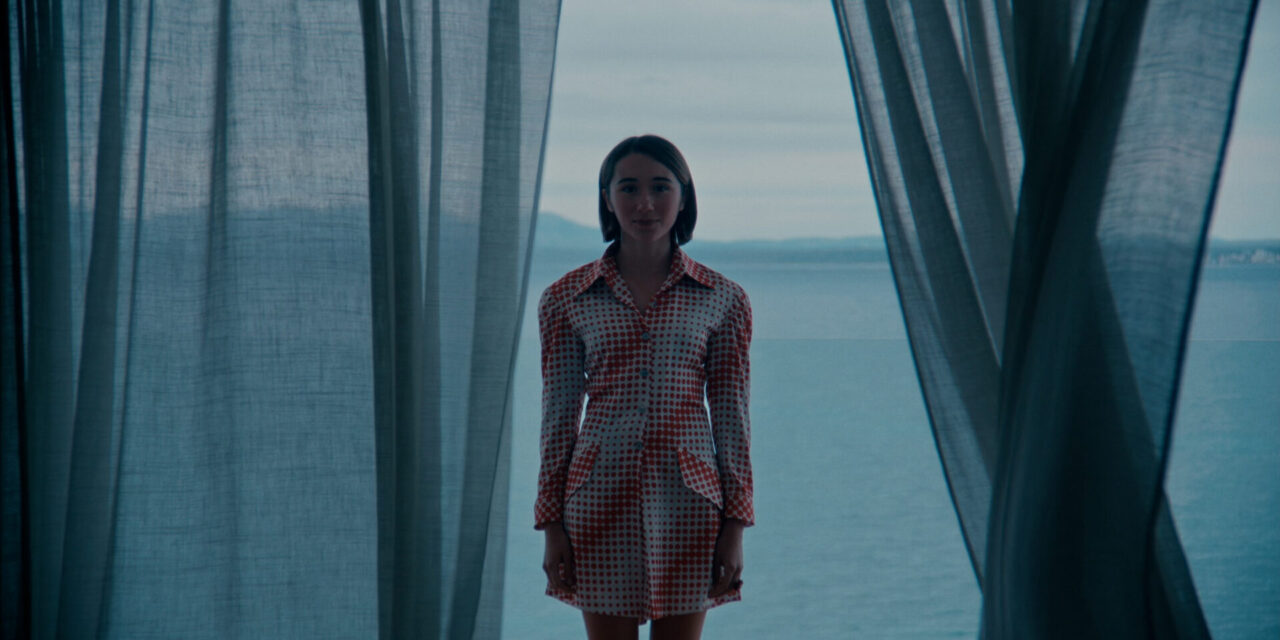
Cata (Zoe Stein) has a real talent for telling stories with a fervor for stretching the truth. In the opening minutes of Lucía Aleñar Iglesias’s “Forastera,” she tells her sister Eva (Martina García) she saw a dolphin while kayaking. It’s a quirky, nonsensical story that Eva shrugs off, but a sense of what’s real and what’s not is important in setting the stage for one of the film’s major themes. There’s a unique way in which we all embody the totem of eulogy, but could it be that an actual spirit from beyond could be illustrating our steps and coloring the lines of a life once lived?

Zoe Stein in “Forastera.”Credit. Grasshopper Films
Aleñar Iglesias establishes that her main protagonist is somewhat of a questionable narrator, but it’s woven into the beautiful fabric making up this unconventional “ghost” story. The writer/director uses lighting, a fixed point of view, and the placement of dialogue to show the many ways loss takes up space. Both Cata and Eva are staying in Mallorca for the summer with their grandparents, Catalina (Marta Angelat) and Tomeu (Lluís Homar). At first, there are typical hallmarks of a 16-year-old on vacation. There’s a boy Cata likes whom she spends time with. Her grandmother wonders when she’s going to finally take those driving lessons and volunteers Tomeu to help. Agnès Piqué’s cinematography, particularly in the way it displays how breathtaking the ocean looks as Catalina and Tomeu sit on the balcony of their cottage, conveys how much this feels like paradise.
But soon, things take a tragic turn. One evening, Cata finds her grandmother suddenly dead in front of the front stairway. In his grief, we don’t see Tomeu’s cries and despair – it’s viewed from Cata’s point of view. Slowly but surely, Aleñar Iglesias and Piqué begin to obstruct light from coming into what was a warm and lively home. All of a sudden, a reminder like Catalina’s nibble on a dessert serves as a marker for sadness. Something else is happening in concert with this family’s reasoning regarding the family matriarch’s loss. During the funeral, someone comes up to Cata and says, “You look just like her,” referring to her grandmother.
There’s an overtness in the story Aleñar Iglesias is trying to tell, given Cata’s name. As Cata starts wearing Catalina’s clothes and looking at old photographs, she begins almost to embody her late grandmother’s spirit. “Forastera,” which means “stranger,” portrays its brilliance in subtlety and a never-ending grey area. It’s easy to think this is a straightforward ghost/possession story, but the manner in which Aleñar Iglesias tells the story will have you thinking beyond the surface. In one instance, Cata impersonates her late grandmother when a hairdresser calls. Later in the film, some of the antidotes specific to Catalina’s life experience show up in Cata’s everyday life.
It’s not necessarily clear these things are happening in real time. However, it speaks to the things our physical and mental bodies do to either stave off the waves of melancholy that come with death or try to fill the space to soften the blow for others. Pepa (Núria Prims), Cata, and Eva’s mother, has a frosty relationship with Tomeu, which is only exacerbated by this time of grief. The simplicity in “Forastera” lies in telling the story of a family trying to find a pathway forward without a prominent member – how Aleñar Iglesias navigates this time is why the film is so affecting.
Summer is a magical time, especially when you’re a teenager. It’s a formulated space in time where the responsibilities of school and growing up are frozen. For the most part, you look back on those days with fondness. Aleñar Iglesias’s film also made me consider that the loss of a loved one sometimes occupies that same space. You hold on to those memories and take up the mantle of completing their rituals to steal back time – a double-edged sword that serves as a reminder that those shoes may be too big to fill. “Forestera” exists within the in-between of the shock of keepsakes and mementos betraying you and the reconfiguring of life once an important part leaves it for good.