
The pastiche of the enclosed German sci-fi thriller “Brick” would work best as a tight, 30-minute episode of an anthology series. Just imagine waking up one day to find that a large set of magnetized metal bricks had taken over all the exit points of your apartment. No cell service, no internet, and no way out. That’s a well-stocked amount of nightmare fuel. While writer/director Philip Koch puts forth an intriguing premise with a creative use of set design. However, the overall story mechanics, both major and minor, can’t sustain the intrigue to the finish line. The puzzles to come and the overall emotional arc of the main characters don’t deviate enough from an undeniable finish line.
“Brick” begins looking into the turbulent relationship between Tim (Matthias Schweighöfer) and Liv (Ruby O. Fee). At one point, this was a happy and vicarious couple with a baby on the way, as shown by various flashbacks. Unfortunately, they lost the pregnancy and have been locked into a varying suspension of mourning for quite some time. Tim has become so immersed in his work as a game developer that the ties between him and Liv have suffered as a result. Rebuffing her last overture to take a long-awaited trip to Paris for a much-needed getaway, Liv has had it. Before she has a chance to leave Tim for good, they find their main doorway blocked by a weird, black wall with irregular bricks. They try to destroy it to no avail, and it even repels metallic objects if too many are placed on it. Coupled with no running water, it seems like the entire complex is also wrapped up in this wall like a fortress.
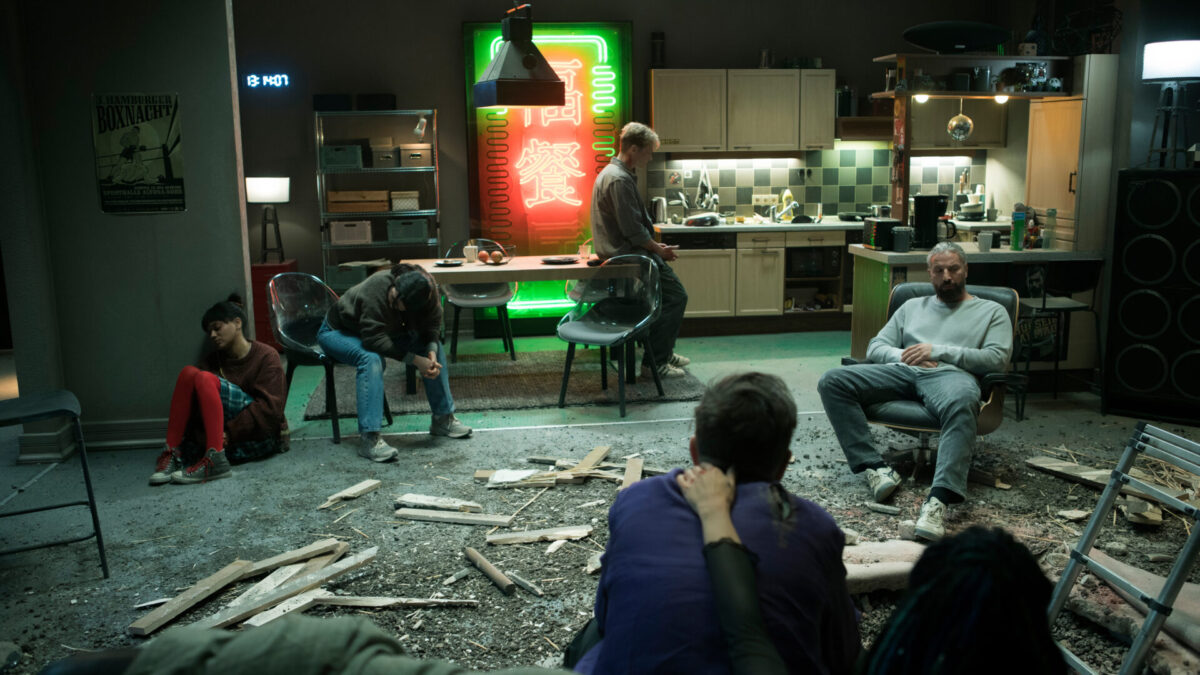
Brick; Sira-Anna Faal; Ruby O Fee; Matthias Schweighöfer; Murathan Muslu. Cr. Courtesy of Netflix © 2025
Schweighöfer and Fee come together to do a serviceable job of portraying a couple at the end of their rope, marred by this crazy circumstance. The issue that Koch’s film faces is that there isn’t enough emotional urgency to compel the audience to want to see these two people survive this ordeal together. Yet, the film centers on it so much that it detracts from the eventual rallying of others to solve what this phenomenon is. Most of the supporting characters exist to fit a particular archetype or foreshadowing, which “Brick” is not concerned with concealing.
There’s another couple, Marvin (Frederick Lau) and Ana (Salber Lee Williams), who just wanted to stay in a swanky Airbnb and perhaps engage in a few controlled substances. A much older, sickly man, Oswalt (Axel Werner), stays with his granddaughter Lea (Sira-Anna Faal), serving as both a method of emotional regret and physical vulnerability within the group. Rounding everything out is a menacing officer, Yuri (Murathan Muslu), who is not afraid to indulge in a conspiracy theory or two.
For some strange reason, Yuri is convinced the impenetrable wall is a blessing in disguise. It’s everybody else who needs to sit down and relax. While the situational scenes progress from point A to point B, Koch and cameraman Alexander Fischerkoesen attempt to freshen things up visually. There is only so much you can do going from a series of rooms in over an hour and a half, not repeating yourself. Yet, “Brick” depicts the story from various angles and points of view to keep the slow morsel of clues flowing. There’s a vague reason why this is happening; one that, if fleshed out more, could be an intriguing premise.
Netflix has two multilayered, societal dystopian films: “The Platform” (2019) and its sequel, released in 2024. The horrors of a depraved caste system in a prison start to wear thin by the time you get to the second film. “Brick” almost overcomplicated things with character development that doesn’t exist beyond conventional setups. A natural energy emerges once the film begins to solve the mystery, which stalls because the emotionality is wasted as the main event, rather than a set piece.