Few instruments carry the identity of West Africa as clearly as the djembe and the talking drum. Both have travelled far beyond their original villages, appearing on world stages, in studio recordings, and in community circles across Europe, the Americas, and the diaspora. Yet despite their shared continent of origin, the two drums operate on remarkably different principles. One is a goblet-shaped hand drum built for explosive dynamics, while the other is an hourglass membranophone designed to imitate the melodic contours of spoken language.
Comparing them side by side reveals a great deal about how African percussion traditions developed in response to geography, language, and social function. When African music lovers meet international collectors, including those exploring Asian women for marriage with shared musical interests, a common question arises: which drum should I learn first? The answer depends on what you want the instrument to say, and that question is what this article explores.
The Djembe: Construction, Grip, and the Three Core Tones
The djembe originated among the Mandinka people of present-day Mali, Guinea, and surrounding regions, with historical ties to the Mali Empire. Carved from a single piece of hardwood, typically lenke, djalla, or iroko, the shell is shaped like a chalice and topped with a shaved goatskin held in place by a system of iron rings and synthetic rope. The result is a drum capable of producing a startling range of sounds from a single surface.
Building the Shell and Head
The carving process traditionally takes place in forested regions where suitable hardwoods grow. A skilled carver hollows the interior with a chisel, leaving a thin waist that acts as a resonating chamber. The upper bowl amplifies the strike, while the narrow stem projects the lower frequencies downward and outward. Rope tuning allows players to tighten the head gradually, bringing the pitch up as the skin stretches with use and humidity.
Hand Position and Posture
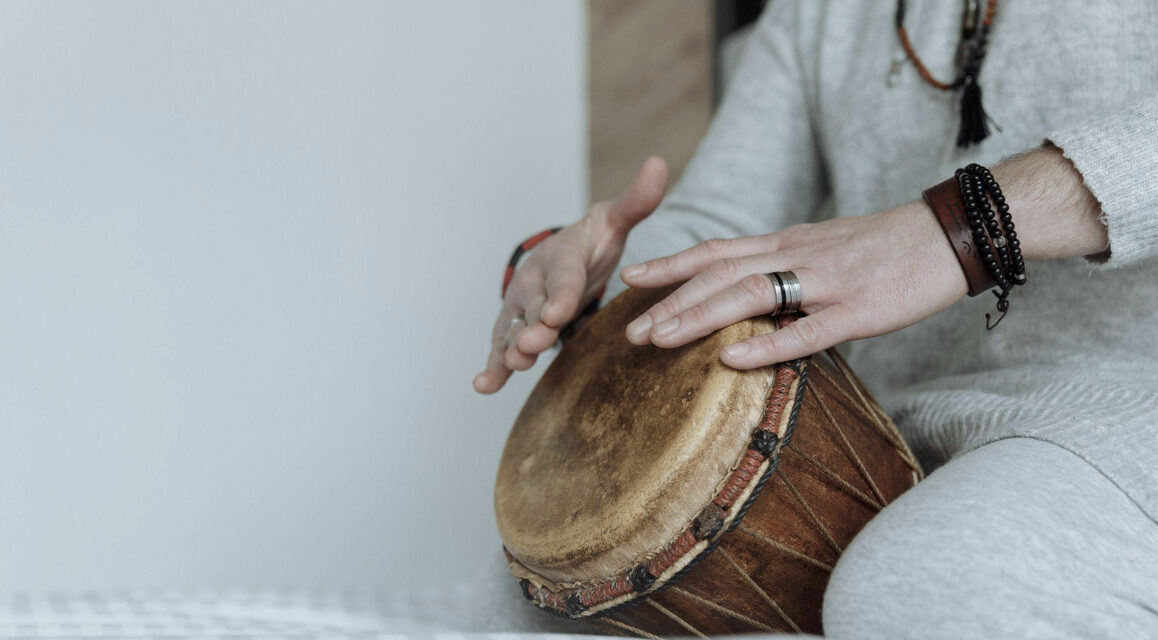
Djembe players sit with the drum tilted slightly forward, held between the knees so the base can breathe. The hands remain relaxed, with fingers together and wrists loose. Tension in the shoulders is a common beginner mistake, and experienced teachers often correct posture before addressing rhythm. A well-seated player can perform for extended periods without unnecessary fatigue, which matters because traditional pieces can run long during ceremonies.
Bass, Tone, and Slap
Three sounds form the vocabulary of djembe playing. Each requires a different hand position and striking technique, allowing musicians to create contrasting rhythms from a single drumhead:
- Bass: Produced by striking the center of the head with a flat hand and releasing immediately to let the low-frequency ring.
- Tone: Created near the edge, where the fingers strike together and bounce away cleanly, producing a clear, resonant sound.
- Slap: The most difficult sound to master, using relaxed fingers and a controlled strike to produce a sharp crack that cuts through an ensemble.
Learning to alternate these three sounds cleanly between left and right hands is the foundation of every djembe rhythm from Kuku to Soli. Beginners often practice each sound separately before combining them into short rhythmic phrases. A metronome can help establish consistency, although traditional instruction places greater emphasis on listening and repeating patterns demonstrated by a teacher.
The Talking Drum: Anatomy, Tension Cords, and Linguistic Mimicry
The talking drum, known as dundun or gangan among the Yoruba, tama in Senegal and Mali, and by many other regional names, has a long documented history. Carvings and oral histories place it in royal courts across West Africa centuries ago, where court drummers were responsible for announcements, praise songs, and the transmission of news across distances. The instrument is instantly recognizable by its hourglass shape and the bundle of leather cords running between two drumheads.
Shell, Heads, and Cords
The shell is carved from relatively lightweight wood, keeping the instrument manageable because it is held under the arm. Two heads of thin goatskin or other animal hide are laced together with leather thongs that run the length of the shell. By squeezing these cords against the body, the player raises the tension on both heads simultaneously, which raises the pitch. Releasing the pressure lowers it again.
The Curved Stick and Arm Pressure
Unlike the djembe, the talking drum is played with a curved wooden beater held in the dominant hand. The non-dominant arm clamps the drum to the ribs, and the elbow and upper arm control much of the pitch variation. Subtle changes in pressure produce glissandi, trills, and sudden pitch jumps. Skilled players can bend a note across a remarkably wide range, giving the instrument its vocal quality.
Speaking Through the Drum
Many West African languages are tonal, meaning that the pitch contour of a syllable changes its meaning. The talking drum exploits this directly. A trained player and a trained listener can exchange familiar proverbs, greetings, and praise verses without spoken words. In Yoruba tradition, dundun ensembles perform oriki, the praise poetry recited at weddings and naming ceremonies, with the lead drum communicating recognizable phrases while supporting drums maintain the groove.
Understanding this musical language involves several connected skills:
- Pitch recognition: Identifying rising, falling, and sustained tones that correspond to patterns in spoken language.
- Cultural knowledge: Learning traditional expressions, praise names, and proverbs associated with particular communities.
- Responsive playing: Adjusting rhythmic and melodic phrases to answer singers, dancers, or other percussionists.
These abilities require considerable practice alongside technical control. Listeners also rely on context to interpret what they hear. Consequently, learning the instrument involves studying local musical conventions rather than simply reproducing changes in pitch.
Musical Roles Across Traditions
While both instruments belong to broader West African percussion families, their roles within an ensemble rarely overlap. Understanding what each drum is expected to do clarifies why players choose one over the other for a given occasion.
| Feature | Djembe | Talking Drum |
| Primary region | Mali, Guinea, Ivory Coast, Burkina Faso | Nigeria, Senegal, Ghana, Togo |
| Main ensemble function | Lead and accompaniment rhythms, call to dancers | Melodic lead, verbal communication, praise singing |
| Playing posture | Seated, drum between knees | Standing or walking, drum under arm |
| Striking method | Bare hands, three tones | Curved stick with arm pressure |
| Pitch control | Fixed, tuned before playing | Variable in real time |
| Typical occasions | Harvest, weddings, initiation, social dances | Royal courts, naming ceremonies, oriki, modern pop |
In a traditional Malinke dance ensemble, the djembe soloist signals the dancers while two or three dunun drums hold the underlying pulse. In a Yoruba juju or fuji band, the talking drum answers the singer line by line, sometimes quoting proverbs that the audience recognizes and laughs at. These roles are not interchangeable, which is why many professional drummers eventually learn both.
The relationship between percussionists and dancers also differs. Djembe soloists frequently respond to movements with rhythmic accents, creating a continuous exchange between sound and physical expression. Talking drum performers may instead direct attention towards a singer, honoured guest, or ceremonial announcement. Both demand close listening, but their musical priorities differ.
Contemporary Stages and Crossover Ensembles
Both drums have found new lives outside their ceremonial contexts. The djembe became a global phenomenon from the 1980s onward, partly through the touring work of Guinean master Mamady Keita and partly through drum circle culture in North America and Europe. Today it appears in workshops, therapeutic settings, and school music programs internationally.
The talking drum travelled a different route. Afrobeat, juju, and highlife carried it into popular recording studios, and artists such as Sikiru Adepoju and Ayan Bisi Adeleke have demonstrated its versatility across musical styles. Producers appreciate its ability to deliver melodic hooks without adding another pitched instrument to the mix.
Modern collaborations occasionally place both instruments within the same arrangement, combining the djembe’s rhythmic intensity with the talking drum’s flexible pitch. Such performances require careful coordination to prevent competing lead parts from overwhelming the music. When arranged thoughtfully, their contrasting timbres create distinctive textures that connect traditional percussion techniques with contemporary styles.
Choosing Between These Two Voices
For a newcomer deciding where to start, practical factors matter. The djembe rewards early practice with immediate, satisfying sound, and group classes are widely available. The talking drum demands more patience because pitch control takes months to develop, and good teachers outside West Africa can be harder to find.
Before purchasing either instrument, consider how each fits your musical interests and everyday circumstances:
- Learning opportunities: Djembe classes and community groups are generally easier to find, while talking drum instruction may require specialist tutors.
- Musical preferences: Choose the djembe for energetic ensemble rhythms and dance accompaniment, or the talking drum for pitch variation and melodic expression.
- Practice conditions: Both instruments produce considerable volume, but their playing positions and techniques create different demands on space, coordination, and physical comfort.
Many experienced percussionists eventually own both. The djembe handles energy, dance, and ensemble drive. The talking drum handles conversation, nuance, and melody. Together they represent contrasting aspects of West African percussion, and learning either one opens a doorway into musical traditions that have shaped global rhythm for centuries.