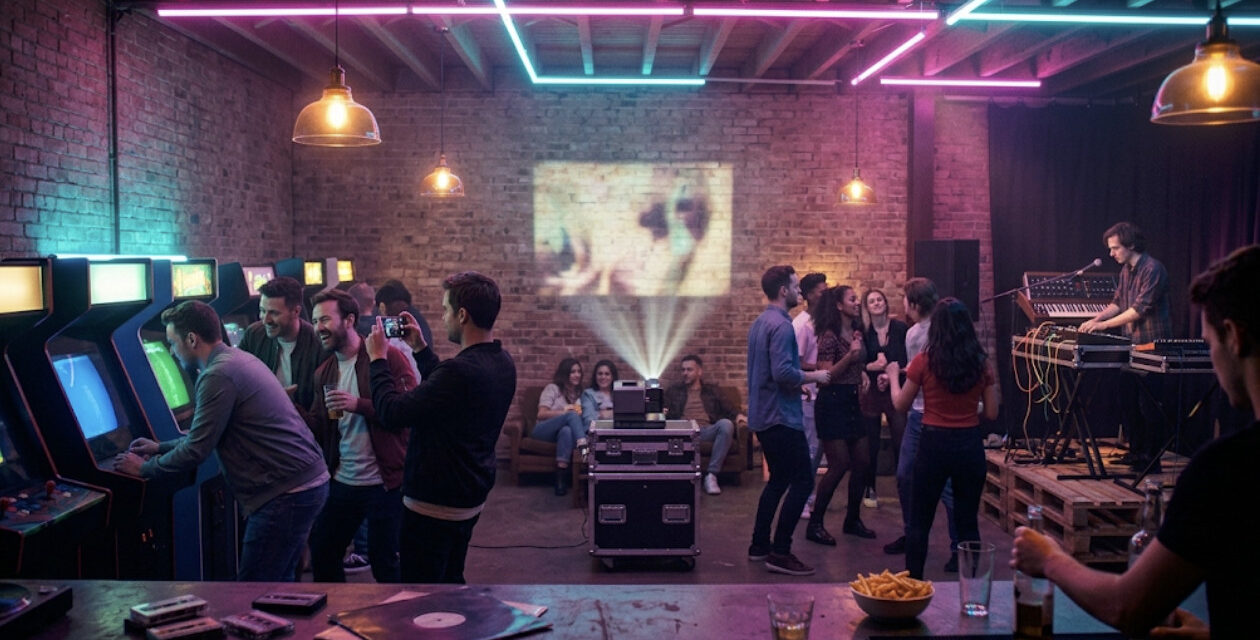
Somewhere between a Netflix finale, a Bandcamp release page and a browser game lobby, the same palette keeps turning up. Hot pink, cyan, black, and a sun made of horizontal stripes. The decade ended forty years ago, and nobody thought to tell the art directors.
A Decade Nobody Remembers Correctly
Sega put Out Run in arcades in 1986: a Ferrari, a coastline, palm trees blurring past. Decades later fans borrowed the game’s name for an entire visual style. The glowing grid lines came from Tron in 1982. Neither one set out to define anything, which is usually how these things happen.
That palette survives because it costs nothing to explain. Magenta on black signals fun and slightly dangerous before a single word finishes loading. Open a lobby of free American slots and the reels sit under the same chrome lettering and glowing edges a synthwave record uses, which says something about how portable this shorthand has become. Designers keep reaching for it because it does the work of a whole paragraph.
Here is the awkward part. The 1980s everyone loves are not the 1980s that happened. They are Blade Runner, arcade cabinets and VHS box art, trimmed down to the good bits.
Stranger Things Turned Nostalgia Into a Format
Volume one of the fifth season landed on Netflix in late November 2025 and pulled 59.6 million views in five days, the biggest premiere week the service had ever posted for an English-language show. The finale went into roughly 600 theaters over New Year as well, taking somewhere between $20 million and $25 million in two days depending which trade you believe. A television episode outgrossing most weekend releases is a strange thing to write down.
Records aside, the Duffer brothers handed every art department a working checklist, and plenty of them have been quietly copying from it since.
- Practical lamps doing the lighting, with a fog machine parked just off frame
- ITC Benguiat, the typeface lifted from Stephen King paperback spines, now shorthand for “something is wrong in this town”
- Wood paneling, station wagons, a shopping mall standing in for the entire economy
- Analog synths under scenes where an orchestra used to sit
Musicians Never Put the Synthesizers Away
Synthwave grew out of a French house scene in the mid 2000s, made by producers who wanted their tracks to sound like film scores that never existed. Drive dragged the sound into daylight in 2011, mostly through Kavinsky’s “Nightcall” and College’s “A Real Hero”. Neither song is actually from the eighties. Most listeners assume otherwise.
Try this. Watch the next retro-leaning video with the sound off and count how many of these show up before the first chorus.
- Wet asphalt, lit from a source nobody can locate
- Chrome type with a gradient running through it
- A car that has no business being on that road
- VHS tracking noise applied to footage shot on a modern digital camera
- Sunsets in colors the sky does not produce
Pop stars work the same seam without the filters. The Weeknd spent two albums inside that synth-pop register and picked up a stadium audience for it. Nobody involved pretends the reference is subtle.
Games Got There First and Never Really Left
Balatro is the strangest evidence. A solo developer working under the name LocalThunk shipped a poker roguelike in February 2024, credited a slot machine game called Luck Be a Landlord among the inspirations, and passed five million copies by January 2025. The cards wobble like a tired CRT monitor. That wobble is a choice rather than a limitation, and it does more sales work than anyone likes to admit.
Casual game design leans hardest on the look because the format has almost no room for setup. No opening scene, no title card, no character to introduce. A player arrives, glances, and decides in about two seconds whether the thing is worth a click. Neon does that job faster than any tutorial.
Which raises a fair question: why this decade and not another? Cheap answer, the eighties were the last era with a visual identity strong enough to survive being squashed onto a phone screen. Beige nineties minimalism does not glow. Nothing about a grey iMac makes a good thumbnail.
Forty years on, a color scheme invented by arcade cabinet illustrators is still selling films, records and games to people who were not alive for any of it. Hard to argue with the results.