
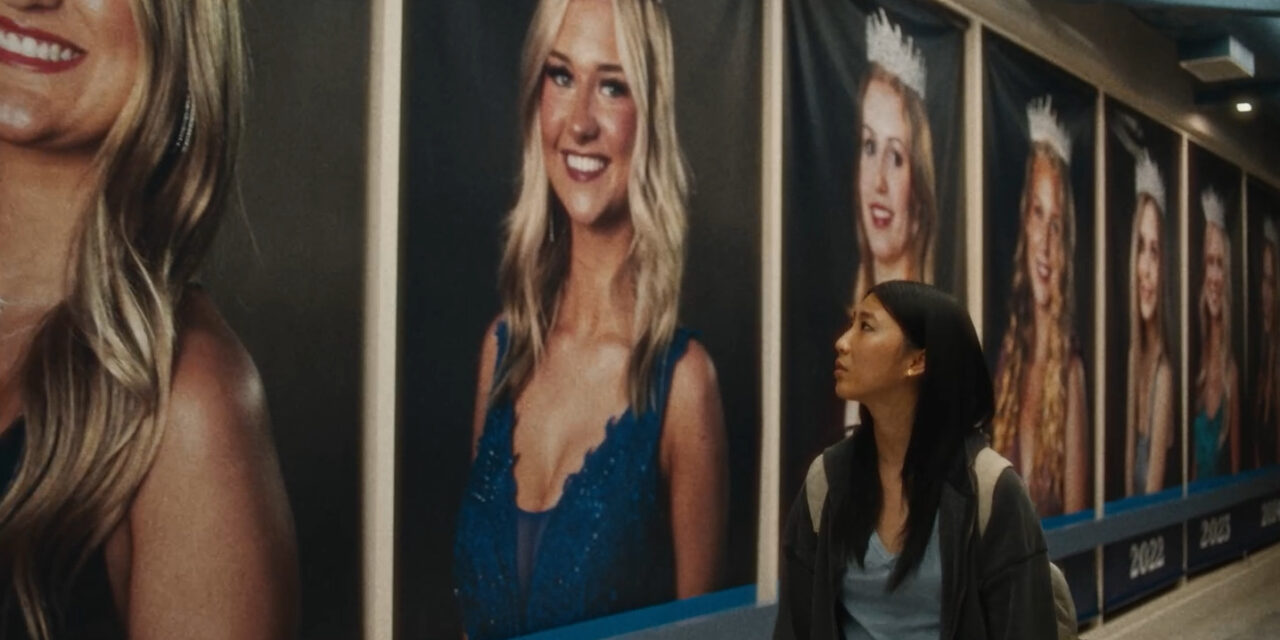
Amy Wang’s “Slanted” exists within the realms of patriotic satire and draws on elements from films such as “Get Out,” “The Substance,” and “Mean Girls” to convey its message. On one level, the overtly hyperstylized billboards featuring guns, blondes, and “All American Burgers” work to some degree. But the film almost loses confidence in the rather smart observations it has to say about cultural assimilation and the difficulties of trying to check the boxes of what a “conventional” American experience is. The film falls into the trap of embodying too much of the tried-and-tested high-school hierarchy energy and not enough of the horrific manifestation of giving up who you are.
A seven-year-old Chinese American named Joan is bombarded with “grand ole flag” imagery as her father (Fang Du) drives through their nondescript white-leaning suburb. Classmates make fun of the way she looks and how her lunch smells. Growing dejected, young Joan sees the mantle of prom queen as a way out of feeling less than. This desire only grows when she becomes a high school student (played by an effective Shirley Chen). Joan has a best friend, Indian-American Brindha (Maitreyi Ramakrishnan), who loves her for who she is. But the allure of rubbing elbows with the popular girl archetype, Olivia Hammond (Amelie Zilber).

Shirley Chen in SLANTED Courtesy of Bleecker Street and Tideline Entertainment
Credit: Bleecker Street and Tideline Entertainment
But even something as simple as dying her hair blonde becomes a source of ridicule for Joan. All seems lost until she receives an inconspicuous text from a company named Ethos. They offer a service free of charge (blaring red flag there!) that turns people of color into complete white citizens under the guise of experiencing “true equality.” In a fit of desperation, Joan jumps at the opportunity with a bit of deceit to get her parents to sign off on it. Within the small span of an afternoon, Joan no longer exists – rather, Jo Hunt (played by McKenna Grace) is born.
“Slanted” does a good job in presenting the societal issues immigrant families have to face when trying to develop what their own “American Dream” appears to be. Joan’s family lives in a modest household, and her father works as a cleaner for the more well-off. Still, Wang characterizes a sense of first-generation pride within this family that Joan can’t access. It’s not something she can find within herself because her parents have experienced a whole life before coming to America. On an emotional level, the isolationism is palpable. It’s when the switch in characters occurs halfway through the film, when “Slanted” chooses to observe the thornier issues of these procedures and of young people, its target audience, with a light touch.
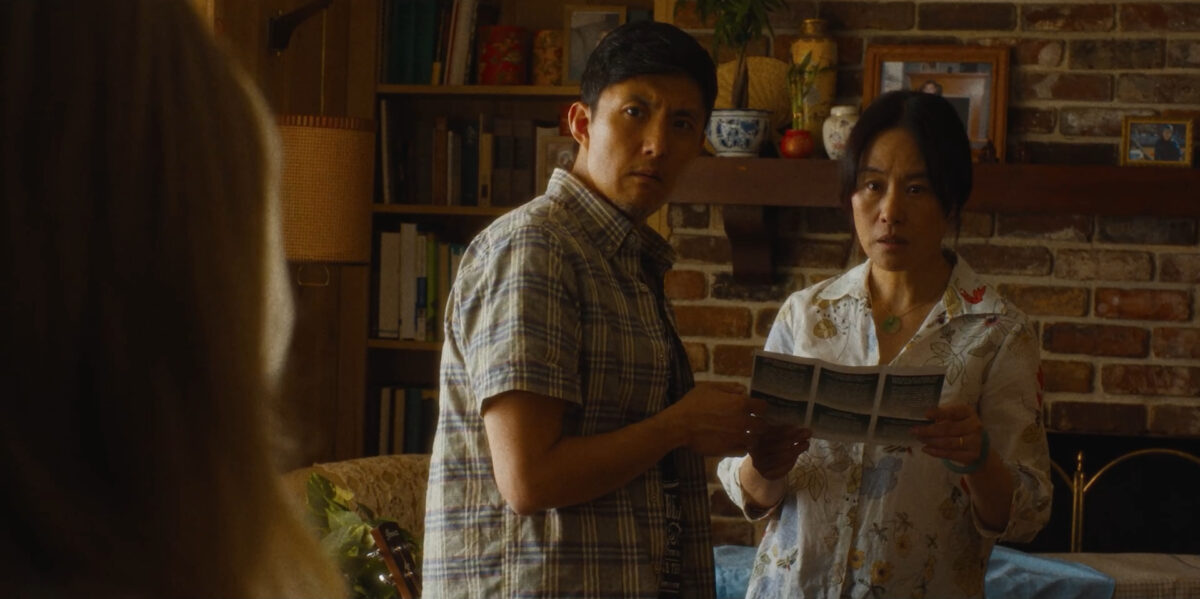
Fang Du and Vivian Wu in SLANTED Courtesy of Bleecker Street and Tideline Entertainment Credit: Bleecker Street and Tideline Entertainment
Joan, or Jo, presents her “new self” to her parents almost immediately, and there’s initial shock and disbelief. But it quickly wears off as they become accustomed to it. “Slanted” then shifts into more of a narrative, with the goal of Jo trying to get in front of Prom Queen maker Olivia for this one purpose. Within her character jumping through hoops and discarding family and friends, there are a couple of physical malformations that Jo has to deal with. She is told that “it’s her old features” fighting back. But the film doesn’t dive into the complexities of what that means beyond the surface.
The problem continually appears in the plot, dipping into the more problematic occurrences of what this town embodies, but suddenly pulling back. For instance, in one of the houses, Joan’s father, Roger, cleans a wall covered in African artwork, with pictures of the owner posing with children in a “Make-A-Wish”-like manner. When Joan visits the Ethos facility, a converted person professes that their new white “likeness” is so much easier. In fact, they have a “whiteness” filter that Joan uses. But we, as an audience, know this. We know there’s an unfortunate penalty people of color have to pay to live an authentic experience in conjunction with the perception of what “Americanism” is.
“Slanted” slows flashes, deepening the contentious nature of immigrant families’ efforts to preserve their uniqueness. However, it lays it by the wayside for the conventional rising-up-the-ranks popularity motif. The film never quite matches the promise or the level of body horror it hints at, or the thorough scrutiny of privilege and how minorities are left holding the bill.