A film editor in Los Angeles once told a story. She was cutting a gambling scene for a mid-budget thriller, and the director kept asking for the same thing: to make it tighter, faster, and more suspenseful. Three days of notes. The same note applies here. She finally asked what he wanted. He thought for a second and said: “I want it to feel like being at the table.”
She had never gambled before. He had lost $400 in his 20s, and he still remembered how it felt.
The difference between how one person understands it physically and another person understands it emotionally is why casino films are still made. The casino floor isn’t a setting. Most of us have felt this way at some point, and filmmakers have been trying to capture it on screen for 60 years.
Some of them get close. Some people do this.
Why the Casino Floor Works as a Film Location
According to Box Office Mojo data from 2024, the top 15 casino gambling films made over $3.8 billion worldwide. That’s not a coincidence. It’s a genre that keeps converting.
But the money isn’t why directors keep going back. They go back because the casino floor does something that almost no other location does for free: it creates a feeling of tension that you can see and read without a villain in the room.
So you have a table. You can use cards, chips, or a wheel. One person is winning. One person is losing. The camera doesn’t need to explain anything. Everyone in the audience understands what’s at stake from the very beginning. You don’t need that in a courtroom. You don’t need it at a crime scene. The casino gives you the best hand.
That’s the technical reason. The emotional reason is different.
Casinos are places where time seems to stop. Nobody checks their phone while holding it with their hand. Nobody answers emails. The outside world seems to stop there, which is something that doesn’t happen often. Movies often show these kinds of places where the usual rules don’t apply. Airports. Hospitals. Trains. Casinos.
And honestly, the fact that real money is changing hands just makes the camera’s job easier. Actors don’t have to pretend to care.
The game’s settings automatically generate stakes. That’s the whole trick.
Scorsese Understood the Music First
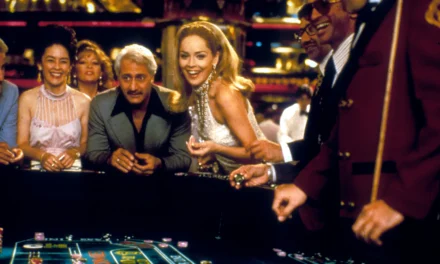
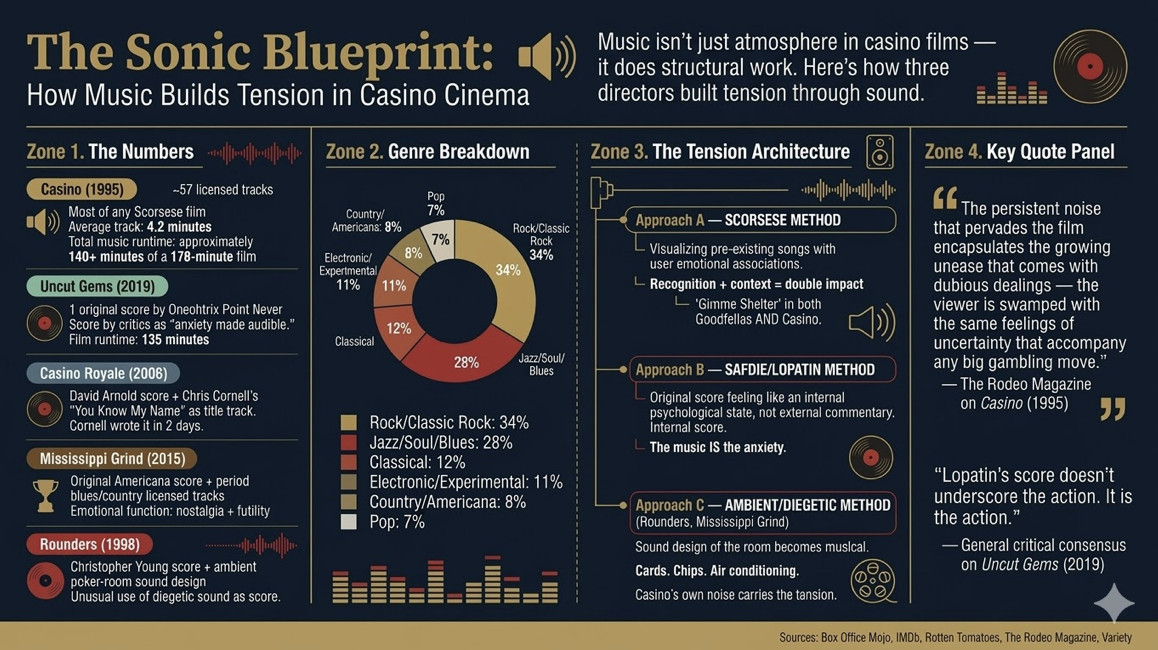
Martin Scorsese’s 1995 film Casino is 178 minutes long and uses about 57 licensed tracks. That’s not a number you hit by accident. That’s a director who knew — before filming even started — that the film’s emotional impact would be created through music.
The most famous example is “Can’t You Hear Me Knocking” by The Rolling Stones. The song is over seven minutes long. It uses a montage of Joe Pesci’s character robbing jewelers and pushing further into chaos. Scorsese let the whole song play. It wasn’t a highlight. Not the chorus. The whole thing. The song’s progression — starting slow and then building up to a longer jam section — mirrors what Nicky Santoro is doing to himself and to Las Vegas.
The music editor and the director both have the final say. And for Substream readers, that’s the part of casino cinema that doesn’t get enough credit.
The Casino soundtrack includes songs by various artists, such as Cream, Roxy Music’s “Love Is the Drug,” Lou Reed’s “Walk on the Wild Side,” Tom Waits’ “Jockey Full of Bourbon,” Muddy Waters, and Otis Redding, as well as the Rolling Stones. It sounds less like a movie soundtrack and more like someone’s real record collection, which is the point. Scorsese wasn’t trying to create a mood board. He was creating a world where the music is as greedy and excessive as the characters.
The result is one of the most carefully constructed sound experiences in American film history. The setting is a casino.
“The persistent noise that pervades so much of the film’s three-hour runtime encapsulates the growing sense of unease that comes with Ace and Nicky’s dubious dealings.” — The Rodeo Magazine, on Casino’s soundtrack
If you like how music works in movies — not just as background music, but as a part of the story — you’ll love Casino 1995. It’s a great example of how music can enhance a movie. You could teach it in a music theory class.
The Blueprint Nobody Admits They’re Following
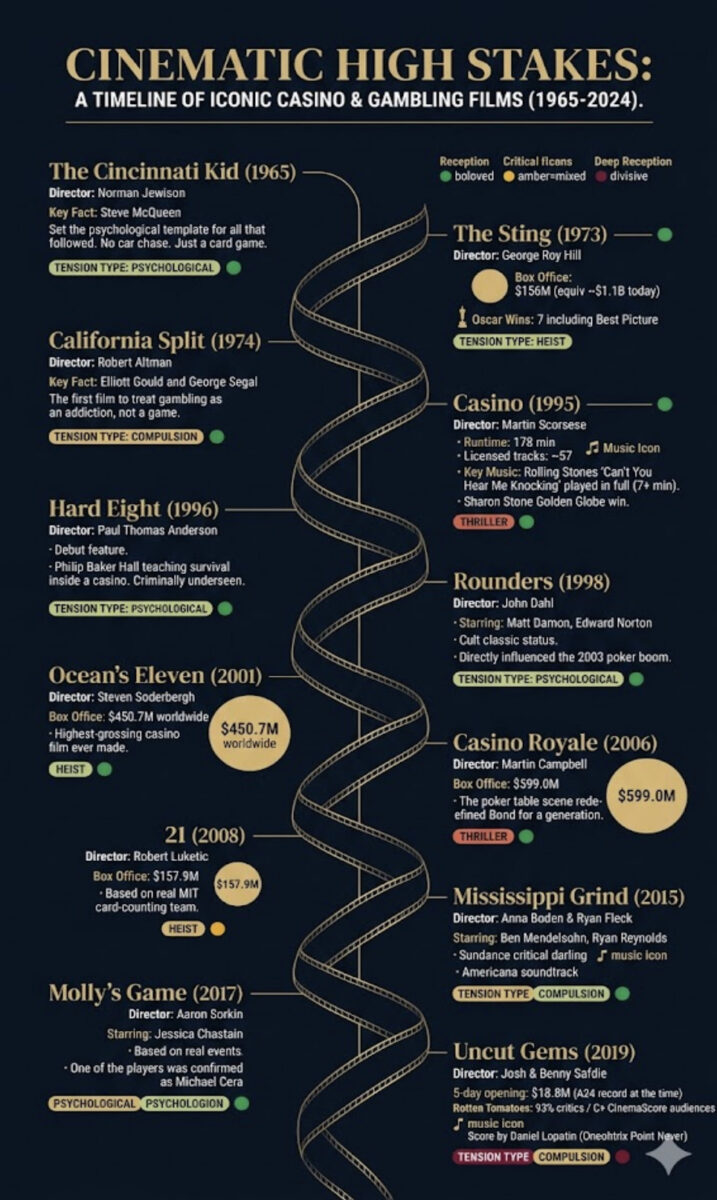
The Cincinnati Kid (1965) did it first, more or less. Steve McQueen plays a young poker player trying to beat the old champions, while Edward G. Robinson plays the unshakeable champ. The most exciting part is a card game. There was no gunfight. There is no car chase. There are just two men at a table, and the camera watches them closely.
It created a model that no one admits to following: the casino as a place where people’s true characters are shown when they’re under pressure. It wasn’t built. Revealed. The pressure was there even before the movie began. The casino just makes it visible.
The next movie was Rounders (1998). Matt Damon and Edward Norton, underground poker, New York, $15,000 debt. The film about Texas Hold ’em is very detailed and shows a lot of love for the craft, like a music documentary does for a specific instrument. John Turturro’s Knish explaining pot odds in the middle of the scene isn’t exposition. It’s one musician explaining to another why certain chord progressions work.
Hard Eight (1996) was Paul Thomas Anderson’s first feature film. Philip Baker Hall teaches a poor kid how to live inside a casino. He teaches the kid how to eat for free, how to act, and how to fit in without getting noticed. It’s honestly the most tender movie ever made about gambling. This may sound strange, but it’s true.
Then Steven Soderbergh got involved.
Ocean’s Eleven (2001) grossed $450.7 million worldwide, according to Box Office Mojo. It did something slightly different from its predecessors — it made the casino into a puzzle box rather than a moral arena. The casino as an obstacle course. Smart, fun, not particularly interested in what gambling actually feels like. But it mainstreamed the aesthetic in a way that opened the door for everything that came after.
21 (2008) took the MIT card-counting story, grossed $157.9 million, and brought blackjack strategy into pop culture in a way that actually changed how people thought about the game.
Casino Royale (2006) gave Daniel Craig his defining early scene at a poker table, and the film understood something important: Bond’s confidence reads differently when he’s betting $115 million than when he’s pointing a gun. The table made him human. The gun just made him Bond.
Uncut Gems Changed the Template in 2019
The Safdie Brothers spent six years developing Uncut Gems. They finally made it with A24, with Adam Sandler, and with a score by Daniel Lopatin (Oneohtrix Point Never) that sounds like what anxiety actually feels like in your chest.
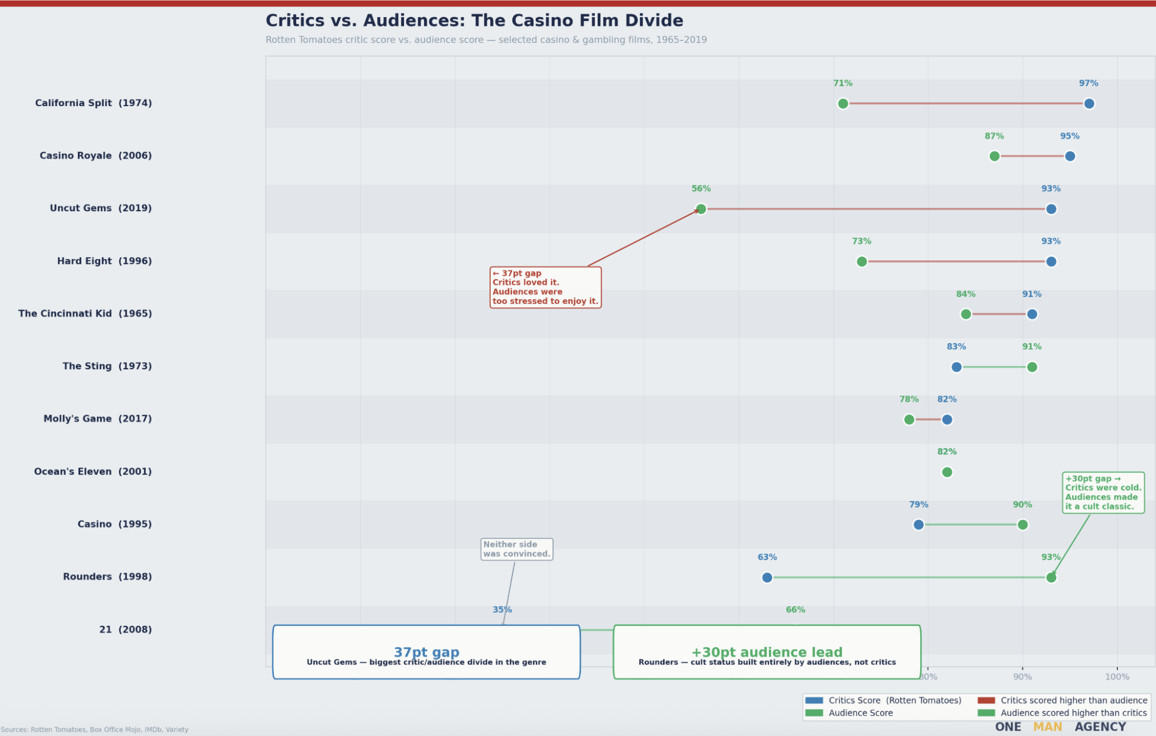
The film opened to $18.8 million in its first five days — A24’s biggest launch at the time, beating Midsommar‘s $11 million. Critics gave it 93% on Rotten Tomatoes. Audiences gave it a C+ CinemaScore, which basically means they were too stressed to enjoy it, which was the point.
Uncut Gems doesn’t use the casino as a metaphor. It uses it as a literal psychological state — Howard Ratner doesn’t gamble at a casino, he lives inside one. Every scene is structured like a hand that’s about to go wrong. The phone calls overlap the conversations which overlap the next crisis which overlaps the next bet. Lopatin’s score doesn’t underscore the action. It is the action. Twelve-tone clusters that feel like your brain when you’ve agreed to something you immediately regret.
So two things happened in 2019 that this film did that nobody had done before. First, it made compulsive gambling feel genuinely neurological rather than moral. Second, it made the audience feel the thing that players actually feel — not the movie version of tension, but the specific, grinding, escalating anxiety of knowing you’re in too deep and still not stopping.
Uncut Gems is not a fun watch. It is an extraordinarily accurate watch. That distinction matters.
What the Best Casino Films Actually Get Right
There’s a myth that casino films work because of glamour. The chips, the suits, the cocktail glasses, Sharon Stone in that dress. And sure, that’s part of it. But the films that actually last are the ones that understand what gambling really is.
Not the outcome. The waiting.
The best casino sequences in film history are almost always about the pause before the reveal. Rounders’ underground games have this. Hard Eight has it almost every scene. Casino Royale’s heads-up finale has it. The camera stays on faces, not cards. Because the information isn’t in the cards. It’s in what people do when they don’t know yet.
Most players who actually know what they’re doing will tell you that’s accurate. The game is mostly waiting with controlled breathing. You’re just watching the number, or watching the dealer’s hands, or watching the other person’s face for anything. If you want to understand what these directors are chasing — that specific texture of suspended attention — spending a few sessions at a platform like visit Wincraft gives you a surprisingly fast shortcut. The interface strips away all the physical atmosphere and leaves you with just the pure mechanics of it. Which is clarifying. You realize pretty quickly that the tension isn’t about the money — it’s about the moment between action and outcome, which turns out to be the same moment every good casino film is about.
That’s not a coincidence. That’s what the setting actually contains.
The Soundtrack Is Half the Movie
This is the part that a Substream reader will already know in their gut, but it’s worth saying specifically.
Casino (1995) — discussed above. The Stones, the soul, the jazz, the classical music used as ironic counterpoint. Fifty-seven tracks. A masterclass.
Uncut Gems (2019) — Daniel Lopatin’s original score is technically a hip-hop production method applied to horror-film tension. There’s a track called “The Fly” that sounds like The Weekend’s “Blinding Lights” if it was produced during a panic attack. It’s genuinely one of the most interesting film scores of the last decade, and it came from a casino film.
Rounders (1998) — Christopher Young’s score, plus the ambient poker-room noise used as music. The sound design is doing as much work as the actual soundtrack.
Mississippi Grind (2015) — Ryan Fleck and Anna Boden’s road-gambling film used a deliberately retro Americana sound that made the whole film feel like a conversation happening in 1978, even though it wasn’t. Ben Mendelsohn and Ryan Reynolds, two gamblers driving south from Minneapolis to New Orleans. The music tracked their emotional state the way a really good album does — not by telling you how to feel but by being in the same room as the feeling.
Molly’s Game (2017) — Aaron Sorkin directing his own script, Jessica Chastain as real-life poker ring organizer Molly Bloom. The film used a restrained classical score by Daniel Pemberton that deliberately avoided the usual casino-film energy cues. Pemberton wanted it to feel like Bloom was always thinking several moves ahead, which — given she was running games with players including a former A-list actor, Michael Cera confirmed on record as one of them — she was.
So basically: if you’re interested in how film scores function as part of a film’s argument rather than just its atmosphere, casino films give you more examples per square foot than almost any other genre.
Where Indie Cinema Took It Next
The Safdies weren’t new to the scene. Before Uncut Gems, there was Good Time (2017), where Robert Pattinson runs through Queens at night. It was another Lopatin score, and another film where the gambling instinct (even if it’s not literally gambling) drives every decision. The Safdies built an entire filmmaking style based on what gambling feels like in your body.
Mississippi Grind is underrated. I’m serious. It sounds like a song by Springsteen — two guys on a road trip. One guy doesn’t know how to stop when he’s ahead, and the other guy knows it but still drives with him. The most important thing is the friendship. Gambling is just the metaphor.
The 1989 Hong Kong film God of Gamblers created a whole cinematic universe that ran for years. Chow Yun-fat plays a gambling genius who has lost his memory. These films understand something that American casino movies sometimes don’t: that in some cultures, gambling is a part of social tradition, family duty, and almost fate. The tension in the story isn’t about life or death. It’s communal. It’s a completely different emotional state.
Two for the Money (2005) — Al Pacino and Matthew McConaughey, sports betting, underrated. Pacino’s speech about what a streak feels like is one of the most accurate things ever said on screen about why people keep going.
Mississippi Grind is underrated. — a few card tables and good actors will do it — and because the psychological material is very rich. You don’t need a car chase. You need two people who both want something, and only one of them can have it.
Playing It for Real: The Texture Directors Chase
Almost every interview with directors who’ve made casino films mentions that they all went and sat in a casino for a long time before filming.
Scorsese was already familiar with Las Vegas. The Safdies reportedly played for research. Soderbergh’s team built a fake casino and ran actual games with real dealers to get the muscle memory right.
The thing that sets a film that feels accurate from one that feels like a movie about a casino is the quality of attention that the casino demands from you. It’s not exactly excitement. It’s like waiting, but with more focus. Time gets strange. The room has no windows. You lose track of time in a way that you can’t do anywhere else.
Directors want that feeling when they’re editing. They want cuts that feel like the pause before a flip. They want the camera to capture the same essence as a player. You can’t recreate that from research. You have to experience it first.
That’s why every new generation of filmmakers keeps making the same movies. The setting teaches you something about attention and suspension that you can’t learn anywhere else. And whatever you learn, you bring it to the screen.
What’s Coming Next
The 2025-2026 pipeline has at least three major projects set in or around gambling. Rian Johnson is reportedly working on something related to poker. There have been talks about a sequel to Molly’s Game. Streaming platforms like Netflix and A24’s TV arm are working on several limited series about professional gamblers.
The interesting change is that Las Vegas is no longer the main setting. Macau appeared in Now You See Me 2 (2016) and several other projects related to the James Bond franchise. Online gambling is becoming more common in movies. The 2013 movie Runner Runner is an example of this. Many people did not like the movie, but it was better than people thought. It’s harder to make a cinematic laptop and a live poker feed than a table, but filmmakers are figuring it out.
The tension is portable. That’s the point. You can recreate it anywhere because it exists in the player’s mind, not in the room.
Casino films will continue to be made because the setting has everything a director needs: characters who show their true selves under pressure, music that fits well, and an audience member can understand the question from the first frame.
Will they or won’t they?
That’s the whole genre. And honestly, that’s enough.