Las Vegas remains one of America’s most mythologized cities. Neon and casino luxury sit literally in the middle of the Mojave Desert, the promise of easy money sits alongside the cost of losing, and dreams get crash-tested here every night. Against the backdrop of new releases about the decline of classic shows and debates about the future of the Strip’s entertainment industry, the editorial team has put together a selection of films that let you see the city more fully than any guidebook can.
How does the classic image of Vegas square with the rise of the iGaming industry?
Films give what postcards and commercials lack: the backstage of revue shows, motels on the outskirts, residential neighborhoods, Nevada’s desert highways, and the quiet of the Mojave. Each of the films below turns Vegas into both a spectacle and a space of anxiety, temptation, and burnout. They show Vegas from different angles, sparking curiosity and the urge to see the famous city for yourself. For decades, cinema gave audiences a fairy tale about Las Vegas, but the growth of the iGaming industry is changing everything.
To experience the thrill of gambling, you no longer need to travel to Nevada. People can play without leaving the couch. Such platforms offer a wide selection of games, from classic slots to entertainment with new gameplay mechanics. Many online casinos also offer bonuses and promotions for new and returning players. This is happening not only in the United States, but also in other regions—from Europe to New Zealand. We used a search engine and picked a top site offering no deposit bonuses casino. The very fact that there are more and more of these bonus offers suggests the market is growing. And that means a potential drop in revenue for traditional land-based casinos.
All of this shows that a more compelling reason is now needed for a trip to Las Vegas than simply to place a couple of bets. So whether new films will also continue to popularize the city is an open question.
The selection is arranged chronologically, from the glossy classics of the 1960s to a more sober modern view, and within that chronology the transitions are smoothed out with thematic blocks.
Viva Las Vegas (1964)
Race car driver Lucky comes to the city for a competition, but ends up without an engine and without money. He gets a job at a hotel-casino and meets the charismatic Rusty. Their rivalry quickly grows into a romance set against music, dancing, and racing.
A cinematic portrait of Vegas in the era of early glamour—lightweight and not yet shaped by a corporate grip. The Strip here feels like one long celebration, where speed, the stage, and romance merge into a single spectacle.
Locations: Flamingo, Tropicana, the Strip.
One from the Heart (1982)
A couple with an “ordinary” life breaks up on their anniversary and, separately, looks for new love, slipping into fantasy. Reality is deliberately theatrical, and feelings sound louder than facts.
A rare look at the city as a constructed illusion: Coppola didn’t film the real Strip, but built it entirely on a soundstage, turning Vegas into a metaphor for the artificiality of romance. Tom Waits and Crystal Gayle’s score makes the story almost dreamlike against a neon backdrop.
Locations: a soundstage “version” of Las Vegas, stylized as the Strip.
Queen of Diamonds (1991)
An unflappable blackjack dealer lives in a cycle of shifts and almost imperceptible events. The city around her is loud, but the heroine remains detached.
An anti-gloss story about those who keep the “gambling machine” running, only to dissolve within it themselves. The rhythm of repetition shows loneliness inside a city built for pleasure.
Locations: Downtown, the Fremont Street area.
Showgirls (1995)
Nomi arrives with no backup plan and makes her way from cheap stages to a big production, running into competition and the seedy underside of the industry.
A hyperbolized, deliberately loud portrait of 1990s Vegas that became a cult classic despite bombing at the box office. Useful as a cultural marker of the era and a look into the mechanisms of show business.
Locations: Tropicana, the Strip, the backstage of revue shows.
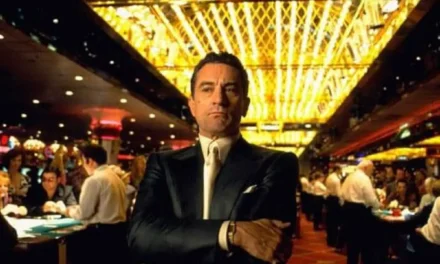
Casino (1995)
A casino manager and a mob enforcer try to hold onto a gambling empire during the breakdown of the old rules. They are undone by mutual distrust and personal addictions.
One of the most accurate screen portraits of the mob era: rivers of cash, the mechanics of big gaming floors, and the inevitable coexistence of luxury and violence. Vegas here is not a backdrop but a system that chews people up.
Locations: Riviera interiors, “old-school” casinos.
Leaving Las Vegas (1995)
A screenwriter who has lost his footing in life arrives with the decision to slowly destroy himself and grows close to a woman who also lives on the edge.
The most painful look at the city beyond postcards. Cheap motels, side streets, and the feeling that neon can’t save you from emptiness. Nicolas Cage won an Oscar for this role, and the film showed Vegas as a place where it’s easy to disappear while still in plain sight.
Locations: motels and bars off the Strip’s front-facing glamour, the city’s nighttime streets.
Fear and Loathing in Las Vegas (1998)
A journalist and a lawyer arrive “for work,” but the trip turns into a chaotic, paranoid sprint through hotels and their own fears.
A deconstruction of Vegas as a promise of happiness: instead of glamour—sensory overload, absurdity, and the feeling of the road running out. The contrast of neon and desert works as a diagnosis of the era.
Locations: Circus Circus, the Strip, the Mojave Desert, Nevada roads.
Ocean’s Eleven (2001)
A team of professionals comes together to rob several casinos, and the leader’s personal motives add risk to a flawlessly calculated plan.
A portrait of “corporate” early-2000s Vegas: architecture, luxury, and the city as the perfect showcase for a stylish spectacle. The moment when the myth is now being sold as a brand.
Locations: Bellagio (including the fountains), MGM Grand, Mirage, the Strip.
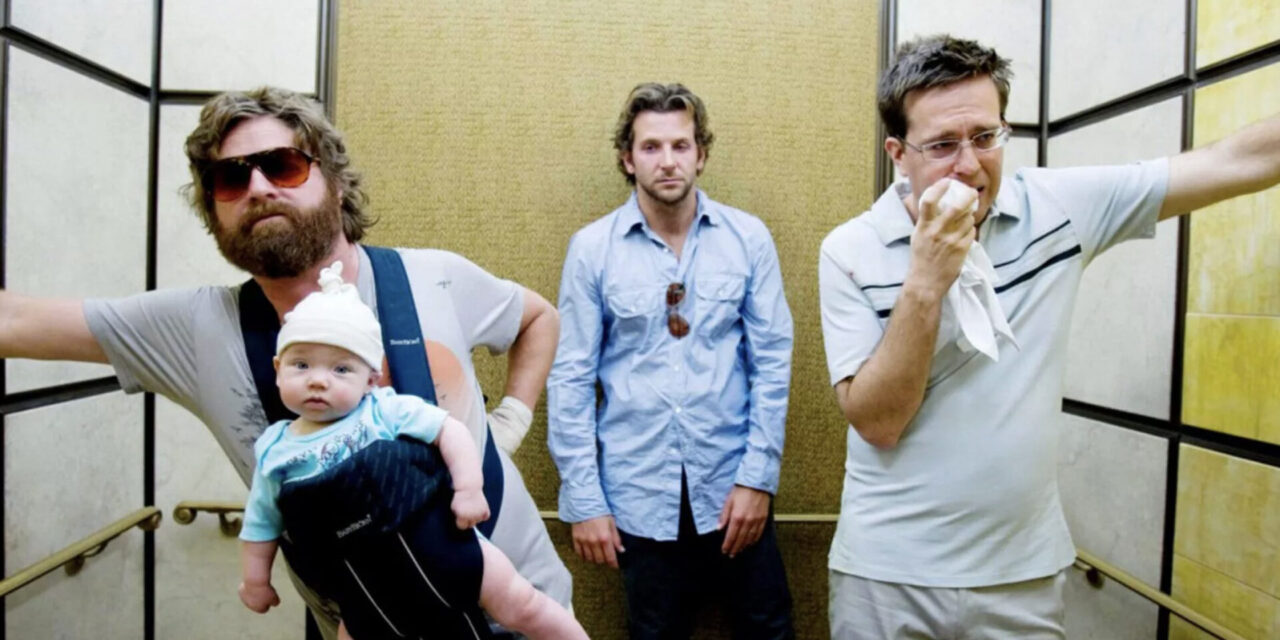
The Hangover (2009)
Friends wake up after a bachelor party with no memory of the night and no groom. From scattered clues, they reconstruct the route, running into ever more absurd consequences.
A modern formula of “anything is possible in Vegas,” where hotel luxury underscores how far things spiral into absurdity. A telling example of how pop culture reassembled the city’s image into a comedic spectacle.
Locations: Caesars Palace, the Strip.
The Last Showgirl (2024)
An experienced dancer learns that her long-running show is being shut down and is left face to face with the need to redefine herself without the stage that gave her life meaning.
A story about the human cost of change on the Strip: live performance craft gives way to “tech-driven” formats, and age and invisibility become part of the profession. Pamela Anderson in the lead role shows that Vegas is not only a party, but also an industry that knows how to forget people fast.
Locations: backstage areas and auditions, the modern Strip as the backdrop to a changing era.